Chapter 2 · Section 8
Pulse Diameter Variability and Merger-Origin Dynamics
What if our Universe's fundamental temporal quantum was determined by a cosmic collision billions of years before the Big Bang? Building upon the Zinf Unit (ℨ) as the invariant quantum of successful closure, we examine how the realized Pulse Diameter (PD) at any recursion level is modified by the astrophysical conditions of Universe genesis. Binary Pulse Theory identifies Pulse Diameter Variability (PDV) as evidence that fundamental temporal scaling depends on black hole mass, spin, and topology at the moment of Prime Pulse Bifurcation.
Universes seeded within Binary Black Hole Mergers inherit Compressed Harmonic Scaling due to injected spin energy and Gravitational Wave Interference, producing a shorter local Planck time than single Schwarzschild-derived domains. Polchinski's string theory compactification scenarios (Polchinski, 1998) reveal variations in effective Planck scales arising from topologically complex genesis events, aligning with PD shortening predicted for binary Kerr mergers.
BPT's working hypothesis, set at the Kerr floor (Part 6.9), places our Universe's Harmonic Signature at a Binary Kerr–Kerr Merger Origin (G), implying a double-injection harmonic profile distinct from single-well progenitors — with implications for cosmic heritage and temporal foundations.
Universe Classification Based On Genesis Parameters
In Binary Pulse Theory, a universe's pulse is set at birth by the ratio of its Null Mass to the Planck Mass: the heavier the well, the slower the child's Local Pulse Tempo and the longer its life. Together with the failed case, this gives a simple taxonomy of cosmic outcomes.
Universe Classification by Genesis Parameters G
Null Mass | M∅/M_P | Child's Tempo ①⥂⧗′⌂/①⥂⧗⌂ | Genesis Type | Universe Characteristics |
|---|---|---|---|---|
Super-Critical | 10⁶ | 10³ | Hyper-Genesis | Slow-pulsing and long-lived; every pulse carries 10³ times the bits |
Critical | 1 | 1 | Standard Genesis | Pulses at its parent's Local Pulse Tempo; normal evolution |
Failed | any | — | Failed Genesis | Seeds no child; its data returns to the Source without continuing back (Part 3.9) |
➢ Classification of emergent universes on the Local Pulse Tempo. No Null Well forms below one Planck mass, so a mass ratio below 1 is not a universe class. A heavier well gives a slower child, ①⥂⧗′⌂ = ①⥂⧗⌂ · (M∅/M_P)^½ (Part 6.5): it carries more bits in every pulse and lives longer in its parent's time. Failure is not set by mass: a collapse that falls short of the data-energy threshold seeds no child whatever its mass (Part 3.9). A merger-compressed core is the exception to slower (Part 6.5): it can give a faster child, never faster than ℨ.
The Null Mass ratio encodes each universe's pulse from inception, linking its longevity to its genesis conditions. In this light, our Universe's stability reflects a balanced genesis parameter, showing that cosmic endurance is written into its computational origin.
Comparison with Classical Cosmological Models
By examining the comparison between BPT Null Well Genesis and Standard Big Bang models, we can understand how computational reactivation mechanisms differ fundamentally from classical cosmological origins, revealing the advantages of discrete state transitions over undefined singularities in explaining cosmic genesis.
BPT Null Well Genesis versus Standard Big Bang G
Aspect | Big Bang Model | BPT Null Well Model |
|---|---|---|
Initial State | Undefined singularity | Well-defined null state |
Genesis Mechanism | Explosive expansion | Computational reactivation |
Information Fate | Lost at singularity | Preserved in boundary encoding, I◫ |
Causality Origin | Light cone emergence | Recursive Pulse propagation |
Time Genesis | Continuous from t=0 | Discrete at τ=τ⇌ |
Where:
- P(τ_c) [∅] - pulse state at collapse time, well-defined null state
- τ_c [𝕋] - collapse time
- G[0∅] [∅] - genesis function applied to null state
- 0∅ [∅] - null state representation
- 1⇌ [∅] - genesis state representation
- I◫ [1ᵇ] - surface information content preserved in boundary
- τ⇌ [𝕋] - genesis activation time
- t [𝕋] - continuous time variable in Big Bang model
- [∅] - quantities without physical units, pure numerical ratios or mathematical constants
Dimensional analysis: [∅] = [∅] , [∅] = [∅] , [∅] = [∅] , [𝕋] = [𝕋], [𝕋] = [𝕋] ✓ The comparison variables are dimensionally consistent across both cosmological models.
➢ Fundamental differences between undefined singularity-based cosmology and well-defined computational state transitions, demonstrating BPT's advantages in causality preservation, information conservation, and discrete temporal genesis mechanisms over classical continuous expansion models.
The Comparison with Classical Cosmological Models framework reveals how BPT Null Well Genesis provides mathematically well-defined alternatives to Big Bang singularities through computational reactivation, discrete temporal origins, and complete information preservation, proposing answers to fundamental problems in classical cosmology through well-defined cosmic genesis mechanisms.
Pulse Diameter Variability Definition and Harmonic Relations
In Binary Pulse Theory, the pulse diameter — the fundamental spatial unit inherited at genesis, crossed in one Pulse Rhythm — is not a universal constant but a variable shaped by the dynamics of progenitor collapse. Each emergent universe inherits its temporal quantization from the black hole conditions that seeded it, with recursion depth, black hole class, and merger dynamics setting the scale.
Mass curvature, spin injection, and axis alignment each act as independent compression factors, combining multiplicatively to determine how tightly or loosely time is quantized in the newborn domain. In this way, temporal architecture is not random but algorithmically transferred across cosmic generation cycles, binding the rhythm of a universe’s time to the exact properties of the collapse event that birthed it.
Pulse Diameter Variability G
Pulse Diameter Variability describes how a universe's Pulse Diameter and its Pulse Rhythm shift with recursion level and computational collapse origins at the Zinf scale. Compression arises from mass, spin, and alignment factors operating through the fundamental computational substrate. Time's quantization is thus an inherited imprint of collapse dynamics rather than an arbitrary parameter.
Local UniSpheral Recursion Level Pulse Diameter G
⊕(ℨ)(n) = 𝒞→ × ↁℨ⧖ × 2²⁰² × f₀²⁰² × ⟪F⟫(⟐(ℨ), ☤(ℨ), ⧬(ℨ))
Dimensional analysis:
Where (from the book): 1 [∅], 6 [∅], 202 [∅], 2²⁰² [∅], n [∅], 1/6 [∅], a₁(ℨ), [∅]
[𝕃]
[𝕃·𝕋⁻¹] × [ℨ] × [∅] × [∅] × [∅]([𝕄], [∅], [∅]) = [ℨ·𝕃·𝕋⁻¹] × [∅] × [∅] × [∅]([𝕄], [∅], [∅]) = [ℨ·𝕃·𝕋⁻¹] × [∅] × [∅]([𝕄], [∅], [∅]) = [ℨ·𝕃·𝕋⁻¹] × [∅]([𝕄], [∅], [∅]) = [ℨ·𝕃·𝕋⁻¹] × [∅] = [ℨ·𝕃·𝕋⁻¹]
[𝕃] = [ℨ·𝕃·𝕋⁻¹] ✓ Valid PulseCore Verified ✓
Local Pulse Diameter scaling with 202nd harmonic level and collapse parameters at Zinf scale
UniSpheral Compression Factor for Merger Origins G
⟪F⟫(M₁(ℨ), M₂(ℨ), a₁(ℨ), a₂(ℨ), θ⧬(ℨ)) = ⟢(ℨ)(M₁(ℨ) + M₂(ℨ)) × ☤(ℨ)(a₁(ℨ), a₂(ℨ)) × ⟣(ℨ)(θ⧬(ℨ))
Dimensional analysis:
[∅]([𝕄]([ℨ]), [𝕄]([ℨ]), [∅]([ℨ]), [∅]([ℨ]), [∅]) = [∅]([𝕄], [𝕄]([ℨ]), [∅]([ℨ]), [∅]([ℨ]), [∅]) = [∅]([𝕄], [𝕄], [∅]([ℨ]), [∅]([ℨ]), [∅]) = [∅]([𝕄], [𝕄], [∅], [∅]([ℨ]), [∅]) = [∅]([𝕄], [𝕄], [∅], [∅], [∅]) = [∅]
[∅]([𝕄]([ℨ]) + [𝕄]([ℨ])) × [∅]([∅]([ℨ]), [∅]([ℨ])) × [∅]([∅]) = [∅]([𝕄] + [𝕄]([ℨ])) × [∅]([∅]([ℨ]), [∅]([ℨ])) × [∅]([∅]) = [∅]([𝕄] + [𝕄]) × [∅]([∅]([ℨ]), [∅]([ℨ])) × [∅]([∅]) = [∅]([𝕄]) × [∅]([∅]([ℨ]), [∅]([ℨ])) × [∅]([∅]) = [∅] × [∅]([∅]([ℨ]), [∅]([ℨ])) × [∅]([∅]) = [∅] × [∅]([∅], [∅]([ℨ])) × [∅]([∅]) = [∅] × [∅]([∅], [∅]) × [∅]([∅]) = [∅] × [∅] × [∅]([∅]) = [∅] × [∅]([∅]) = [∅] × [∅] = [∅]
[∅] = [∅] ✓ Valid PulseCore Verified ✓
Multiplicative compression from mass, spin, and alignment effects
UniSpheral Explicit Functional Forms G
⟢(ℨ)(M⊚(ℨ)) = (M(ℨ)/M⊚(ℨ))^(1/6)
Dimensional analysis:
Where (from the book): 1 [∅], 6 [∅], 202 [∅], 2²⁰² [∅], n [∅], 1/6 [∅], a₁(ℨ), [∅]
[∅]
([𝕄] ÷ [𝕄])^([∅]) = ([𝕄] ÷ [𝕄])^([∅]) = [∅]^([∅]) = [∅]
[∅] = [∅] ✓ Valid PulseCore Verified ✓
Mass-sum curvature function with sixth-root scaling
☤(ℨ)(a₁(ℨ), a₂(ℨ)) = 1 - κ☤(ℨ) · (a₁²(ℨ) + a₂²(ℨ))^(1/2)
Spin injection function with square-root scaling of the combined spins
⟣(ℨ)(θ(ℨ)) = 1 - κ⟣(ℨ) · sin²(θ⧬(ℨ)/2)
Dimensional analysis:
Where (from the book): 1 [∅], 6 [∅], 202 [∅], 2²⁰² [∅], n [∅], 1/6 [∅], a₁(ℨ), [∅], 1/2 [∅]
[∅]([∅]([ℨ])) = [∅]([∅]) = [∅]
[∅] - [∅] × [∅]([∅] ÷ [∅]) = [∅] - [∅] × [∅]([∅]) = [∅] - [∅] × [∅] = [∅] - [∅] = [∅]
[∅] = [∅] ✓ Valid PulseCore Verified ✓
Alignment function with half-angle dependence
Where:
- ⊕(ℨ)(n) [𝕃] – Pulse Diameter at recursion level n at Zinf scale
- ↁℨ⧖ [ℨ] – Zinf data rhythm, ℨ/2; the one-way Zinf transition (ℨ, the Zinf Unit, is the full cycle)
- 𝒞→ [𝕃·𝕋⁻¹] – light speed; with ↁℨ⧖ it gives the Zinf Pulse Diameter, ≈ 3.423 × 10⁻⁹⁸ m
- 2²⁰² × f₀²⁰² [∅] – harmonic scaling with baseline null-well heritage at level 202 (2²⁰² ≈ 6.43 × 10⁶⁰, f₀²⁰² ≈ 39.5; with ⟪F⟫ = ⟪C⟫ ≈ 0.93 for our one merger, the product is (2f)²⁰² ≈ 2.361 × 10⁶²)
- n [∅] – recursion level index
- ⟪F⟫ [∅] – boundary interface compression factor; for a merger origin it is the origin compression ⟪C⟫ (≈ 0.93 for ours)
- ⟐(ℨ) [𝕄] – collapse class mass at Zinf scale
- ☤(ℨ) [∅] – spin function parameter at Zinf scale
- ⧬(ℨ) [∅] – merger configuration parameters at Zinf scale
- ⟢(ℨ)(M⊚(ℨ)) [∅] – mass-sum curvature term at Zinf scale
- M(ℨ) [𝕄] – critical mass reference at Zinf scale
- M⊚(ℨ) [𝕄] – total merger mass at Zinf scale
- 1/6 [∅] – sixth root fractional exponent
- ☤(ℨ) [∅] – spin injection term at Zinf scale
- κ☤(ℨ) [∅] – coupling parameter for spin effects at Zinf scale
- a₁(ℨ), a₂(ℨ) [∅] – dimensionless spin parameters at Zinf scale
- 1/2 [∅] – square-root exponent on the combined spins; the alignment term takes the half-angle θ⧬(ℨ)/2
- ⟣(ℨ) [∅] – spin-axis alignment factor at Zinf scale
- κ⟣(ℨ) [∅] – coupling parameter for alignment effects at Zinf scale
- sin² [∅] – squared sine function
- θ⧬(ℨ) [∅] – spin axis orientation difference at Zinf scale
- 1 [∅] – unity constant
- 6 [∅] – sixth power constant
- 202 [∅] – our specific harmonic level
➢ UniSpheral Pulse Diameter variability demonstrates that temporal quantum compression emerges from computational collapse dynamics at the Zinf scale, where mass, spin, and alignment effects combine multiplicatively to determine inherited temporal quantization through systematic compression factor relationships.
The UniSpheral Pulse Diameter Variability Framework establishes that universe temporal units are not arbitrary constants but inherit compression characteristics from their computational collapse origins at the Zinf level. Mass-sum curvature, spin injection, and alignment factors operate independently through the substrate architecture, combining multiplicatively to produce total compression effects that scale with harmonic depth. This reveals that time quantization carries forward the computational heritage of collapse events, making temporal units into encoded records of genesis dynamics rather than fundamental parameters, demonstrating how the computational substrate preserves collapse history through systematic Pulse Diameter inheritance within the UniSpheral architecture.
Black Hole Class Effects on Pulse Diameter G
Class | Geometry & Spin | PD₀ Scaling Effect | Harmonic Signature |
|---|---|---|---|
Schwarzschild | Non-rotating | Baseline | Isotropic |
Kerr | Rotating | PD₀ shortened | Mild anisotropy |
Extreme Kerr | Near-max spin | PD₀ near minimum | Strong anisotropy |
Binary Merger | Two Kerr-type merging | PD₀ compressed via mass-energy sum and spin injection | Multi-harmonic offsets, anisotropic early expansion |
➢ Systematic classification of how progenitor black hole geometry and spin characteristics determine pulse diameter scaling and harmonic signatures, demonstrating direct inheritance relationships between gravitational collapse properties and emergent universe temporal quantization characteristics.
This framework reveals that the temporal heartbeat of every universe carries a harmonic imprint of its origin. Schwarzschild progenitors encode isotropic baselines, Kerr geometries compress time through rotation, extreme Kerr collapse pushes pulse diameter toward its minimal bound, and binary mergers generate layered harmonic offsets through mass-sum and spin coupling.
The result is a taxonomy of pulse signatures, each universe marked by the geometry and dynamics of its ancestral collapse. In this light, time itself is shown to be an inherited quantity: every tick of the cosmic clock echoes the memory of the black hole that spawned it, embedding gravitational collapse directly into the quantized fabric of emergent universes.
Merger-Origin Compression Dynamics
Binary Kerr–Kerr mergers generate null wells with intrinsic PD₀ shorter than either progenitor could produce alone through:
- Mass-Energy Summation: Total mass raises gravitational curvature, deepening potential well
- Spin Injection: Counter-rotating or co-rotating spins impart additional frame-dragging, tightening harmonic closure interval
- Gravitational Wave Interference: Overlapping wavefronts modulate closure geometry, embedding permanent anisotropic bias
Bardeen, Press, and Teukolsky's rotating black hole solutions (Bardeen et al., 1972) demonstrate frame-dragging and horizon deformation effects responsible for interval shortening. Campanelli, Lousto, Zlochower, and Merritt's numerical relativity studies (Campanelli et al., 2007) measured the spin flips and recoil kicks of merging black holes; that such post-merger anisotropy persists as a bias in a child universe is BPT's reading, not theirs.
Null Well Collision Channels and Pulse Diameter Impacts
In Binary Pulse Theory, not all Null Wells are seeded equally — the conditions of their formation define the temporal structure of the universes they generate. Collision channels such as stellar collapse, neutron star mergers, and black hole coalescences imprint distinct compression factors and harmonic signatures onto the emergent substrate.
By classifying these channels, BPT connects astrophysical merger dynamics directly to inherited pulse diameter shifts, showing how genesis conditions predetermine temporal quantization and anisotropy in new universes.
Null Well Collision Channel Classification G
Collision Channel | Description | Predicted C(⇌) Range | PD Shift vs. Baseline | Harmonic Signature |
|---|---|---|---|---|
Stellar Core-Collapse + Companion Collision | Massive star collapses during collision with companion | 0.97 – 0.99 | Mild compression | Slight anisotropy, early structure bias |
NS–NS Merger | Two neutron stars merge, exceeding degeneracy limit | 0.96 – 0.98 | Moderate compression | Symmetric GW interference, minor harmonic offset |
NS–BH Merger | Neutron star tidally disrupted before BH absorption | 0.94 – 0.97 | Significant compression | Directional harmonic bias along disruption axis |
Kerr–Kerr Merger | Two spinning BHs merge, co-rotating or partially aligned | 0.92 – 0.95 | Strong compression | Multi-harmonic offset, anisotropic expansion |
Kerr–Schwarzschild Merger | Spin from Kerr dominates | 0.94 – 0.97 | Significant compression | Mild anisotropy, single-offset pattern |
Extreme Kerr–Kerr Merger | Both BHs near-max spin | 0.90 – 0.93 | Extreme compression | High anisotropy, dense harmonic interference |
Multi-Body Mergers | Hierarchical repeated mergers in dense environment | 0.91 – 0.95 | Strong compression | Layered harmonic profiles from spin history |
Direct Gas Cloud Collapse | Early-Universe gas collision collapses directly to SMBH | 0.98 – 1.00 | Minimal compression | Low-spin isotropic harmonic pattern |
➢ Systematic classification of collision channels determining compression factors and harmonic signatures through formation mechanism inheritance, demonstrating how gravitational wave merger dynamics and progenitor characteristics directly influence temporal quantization properties in emergent universes.
This classification demonstrates that each universe carries a spectral fingerprint of its origin channel: isotropic baselines for direct collapse, layered harmonic offsets for multi-body mergers, and extreme compression with anisotropy for maximal Kerr collisions. In this light, Null Well collisions are not chaotic endpoints but ordered genesis pathways, encoding the merger’s dynamics into the pulse rhythm of emergent universes.
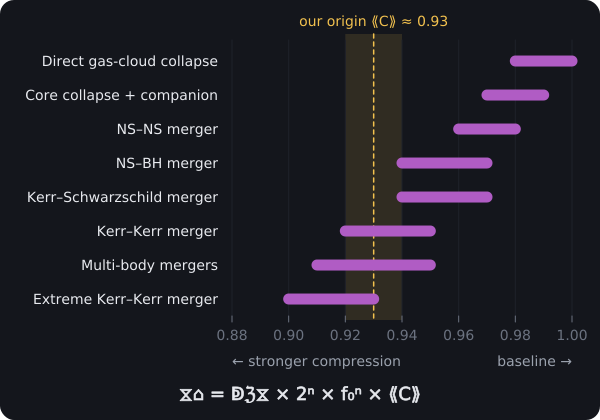
Compression by Collision Channel. The predicted origin compression factor ⟪C⟫ of each Null Well collision channel. The smaller ⟪C⟫, the shorter the inherited Pulse Rhythm, ⧖⌂ = ↁℨ⧖ × 2ⁿ × f₀ⁿ × ⟪C⟫; our universe's high-spin Kerr–Kerr origin sits at 0.92 to 0.94.
Expanded Origin Compression Factor Equation
In Binary Pulse Theory, merger-driven origins are governed by precise compression dynamics at the Zinf scale, where mass, spin, and alignment combine to set the initial temporal scale of emergent universes. The UniSpheral Expanded Origin Compression Factor formalizes this process, showing how progenitor characteristics and coalescence geometry map directly into quantized pulse inheritance through computational substrate mechanisms. This framework provides a systematic method for classifying universes by their cosmic heritage within the UniSpheral architecture.
UniSpheral Origin Compression Factor G
⟪C⟫(ℨ)(origin) = ⟪F⟫(M₁(ℨ), M₂(ℨ), a₁(ℨ), a₂(ℨ), θ⧬(ℨ))
Compression factor based on formation channel at Zinf scale
UniSpheral Merger Dynamics Function G
⟪F⟫(M₁(ℨ), M₂(ℨ), a₁(ℨ), a₂(ℨ), θ⧬(ℨ)) = ⟢(ℨ)(M₁(ℨ) + M₂(ℨ)) × ☤(ℨ)(a₁(ℨ), a₂(ℨ)) × ⟣(ℨ)(θ⧬(ℨ))
Comprehensive merger dynamics function with mass, spin, and alignment components
Where:
- ⟪C⟫(ℨ)(⟴) [∅] – compression factor based on formation channel at Zinf scale
- ⟴ [∅] – origin connector (formation channel/genesis point parameter)
- ⟪F⟫ [∅] – boundary interface merger dynamics function
- M₁(ℨ), M₂(ℨ) [𝕄] – first and second progenitor masses at Zinf scale
- a₁(ℨ), a₂(ℨ) [∅] – dimensionless spin parameters at Zinf scale
- θ⧬(ℨ) [∅] – spin axis orientation difference at coalescence at Zinf scale
- ⟢(ℨ) [∅] – mass-sum curvature term at Zinf scale
- ☤(ℨ) [∅] – spin injection term at Zinf scale
- ⟣(ℨ) [∅] – spin-axis alignment factor at Zinf scale
- ℨ [ℨ] – Zinf Unit scale
- ⧬ [∅] – merger parameter indicator
- ⟪⟫ [∅] – boundary interface indicator
➢ UniSpheral comprehensive compression factor from merger dynamics enables precise Universe classification by cosmic heritage through systematic mathematical modeling of progenitor characteristics and coalescence parameters at the fundamental computational level.
➢ UniSpheral comprehensive compression factor from merger dynamics enables precise Universe classification by cosmic heritage through systematic mathematical modeling of progenitor characteristics and coalescence parameters at the fundamental computational level.
By unifying mass-sum curvature, spin injection, and axis alignment into a single compression equation at the Zinf scale, BPT demonstrates that every universe encodes the full history of its progenitor merger within the computational substrate architecture. These factors determine whether the resulting temporal quantization is mild, significant, or extreme, embedding the collapse channel into the substrate of time itself through systematic compression inheritance. In this light, universes are not arbitrary outcomes but precise computational echoes of their origin dynamics, where merger heritage becomes encoded into the fundamental temporal quantum through UniSpheral compression mechanisms that preserve cosmic genealogy across recursive scaling levels.
Harmonic Scaling Framework for Merger-Origin Universes
The UniSpheral Expanded Origin Compression Factor Equation in Binary Pulse Theory provides a unifying framework for how merger-driven collapse events set the inherited temporal scale of emergent universes at the Zinf computational level. By combining contributions from mass curvature, spin injection, and axis alignment into one multiplicative function operating through the computational substrate, the model allows precise classification of universes according to their progenitor conditions. This equation demonstrates that the quantized structure of time is not emergent chaos but a lawful transfer of compression factors from computational collapse dynamics into the recursive substrate architecture.
UniSpheral Local Pulse Rhythm Zinf Relation G
⧖⌂(ℨ) = ↁℨ⧖ × 2ⁿ × f₀ⁿ × ⟪C⟫(ℨ)(⟴)
Where:
- ⧖⌂(ℨ) [𝕋] – Local Pulse Rhythm in merger-origin domain at Zinf scale
- ↁℨ⧖ [𝕋] – Zinf data rhythm, ℨ/2 (ℨ, the Zinf Unit, is the full cycle from the first successful closure)
- 2ⁿ × f₀ⁿ [∅] – harmonic scaling with baseline null-well heritage across n levels
- n [∅] – recursion level index from prime domain
- ⟪C⟫(ℨ)(⟴) [∅] – compression factor based on formation channel at Zinf scale
- ⟴ [∅] – origin connector parameter
- ⌂ [∅] – local domain indicator
Dimensional analysis:
Where (from the book): 2ⁿ [∅], n [∅], ⟪C⟫(ℨ)(⟴) [∅]
[𝕋]
[ℨ] × [∅] × [∅]ⁿ × [∅] = [ℨ] × [∅]ⁿ × [∅] = [ℨ] × [∅] × [∅] = [ℨ] × [∅] = [ℨ]
[𝕋] = [ℨ] ✓ Valid PulseCore Verified ✓
➢ UniSpheral merger-origin domains demonstrate systematic temporal compression where ⟪C⟫(ℨ)(⟴) < 1 yields ⧖⌂(ℨ) shorter temporal quanta, enabling higher maximum computational operations per unit time and accelerated structure formation through compression-induced temporal acceleration that enhances cosmic evolution rates within the computational substrate architecture.
Harmonic Signature Traits:
- Multi-Harmonic Offsets in CMB anisotropies
- Slightly reduced inferred n₀ relative to baseline mass-only scaling
- Alignment of filament and void structures with post-merger spin axis
- Elevated early galaxy formation rates exceeding single-well model limits
The Planck 2018 anisotropy maps (Planck Collaboration, 2020) are where the Harmonic Signature Traits above would have to be sought; none has been tested yet. JWST's early massive galaxies are the nearest observation to 'elevated early formation rates'.
Through this expanded formulation, BPT shows that universes are computationally indexed by their origin compression factor, C(⇌). Each merger channel, whether mild stellar collapse or extreme Kerr–Kerr coalescence, translates into a specific compression value that defines the universe’s harmonic and temporal fingerprint. In this light, the diversity of universes can be reduced to a spectrum of compression values, each encoding the exact heritage of its genesis event within the UniSphere.
Harmonic Scaling From the UniSpheral Source Impact
The UniSpheral Pulse Rhythm for our local universe represents the emergent temporal quantum that results from all null well characteristics combining together at the Zinf computational level. This single metric encodes the complete heritage of our universe's formation, incorporating null mass, spin characteristics, density parameters, harmonic scaling, and origin compression factors into one unified temporal unit that serves as our fundamental clock rate.
UniSpheral Local Universe Pulse Diameter G
⊕⌂ =
⊕(ℨ) × 2²⁰² × f(M∅(ℨ), ☤(ℨ), ρ(ℨ), ⟪C⟫(ℨ)(⟴), ...)²⁰²
Local universe Pulse Diameter scaled from primordial baseline by harmonic and null well factors
UniSpheral Zinf Unit Scaling Calculation G
⊕⌂ / (𝒞→ · ↁℨ⧖) = (𝒞→ · ⥂⌂/2) / (𝒞→ · ↁℨ⧖) = 2.36 × 10⁶²
Dimensional analysis:
Where (from the book): ⊕⌂ [𝕃], ⊕(ℨ) [𝕃], f(...) [∅], ρ(ℨ) [𝕄·𝕃⁻³], ⟪C⟫(ℨ)(⟴) [∅], 2.695 [𝕋], 1.142 [𝕋], 2.36 [∅], ℨ [ℨ]
[𝕃] ÷ ([𝕃·𝕋⁻¹] × [ℨ]) = [𝕃] ÷ [ℨ·𝕃·𝕋⁻¹] = [ℨ⁻¹·𝕋]
([𝕃·𝕋⁻¹] × [𝕋] ÷ [∅]) ÷ ([𝕃·𝕋⁻¹] × [ℨ]) = ([𝕃] ÷ [∅]) ÷ ([𝕃·𝕋⁻¹] × [ℨ]) = [𝕃] ÷ ([𝕃·𝕋⁻¹] × [ℨ]) = [𝕃] ÷ [ℨ·𝕃·𝕋⁻¹] = [ℨ⁻¹·𝕋]
[∅] × [∅] = [∅]
[ℨ⁻¹·𝕋] = [ℨ⁻¹·𝕋] = [∅] ✓ Valid PulseCore Verified ✓
The distance light covers in half a Planck time, counted in the distance it covers in one Zinf data rhythm (ↁℨ⧖ = ℨ/2), revealing the cosmic scaling factor
Our Universe’s Pulse Diameter Result G
⊕⌂ = 2.36 × 10⁶² · 𝒞→ · ↁℨ⧖
Dimensional analysis:
Where (from the book): ⊕⌂ [𝕃], ⊕(ℨ) [𝕃], f(...) [∅], ρ(ℨ) [𝕄·𝕃⁻³], ⟪C⟫(ℨ)(⟴) [∅], 2.695 [𝕋], 1.142 [𝕋], 2.36 [∅], ℨ [ℨ]
[𝕃]
[∅] × [∅] × [𝕃·𝕋⁻¹] × [ℨ] = [∅] × [𝕃·𝕋⁻¹] × [ℨ] = [𝕃·𝕋⁻¹] × [ℨ] = [ℨ·𝕃·𝕋⁻¹]
[𝕃] = [ℨ·𝕃·𝕋⁻¹] ✓ Valid PulseCore Verified ✓
Our Local Universe Pulse Diameter: the distance light covers in 2.36 × 10⁶² Zinf data rhythms
Where:
- ⊕⌂ [𝕃] – Local Universe Pulse Diameter; emergent spatial quantum for our universe, counted in Zinf units (2.36 × 10⁶² Zinf Diameters ≈ ℓₚ/2 ≈ 8.08 × 10⁻³⁶ m)
- ⊕(ℨ) [𝕃] – Primordial Pulse Diameter; fundamental baseline from first/Zinf universe (= 𝒞→ · ↁℨ⧖, the distance light covers in one Zinf data rhythm ℨ/2)
- 2²⁰² [∅] – the pure doubling over 202 levels (≈ 6.43 × 10⁶⁰); with the heritage f(...)²⁰² ≈ 36.7 the product is the Local Universe Harmonic Number ⚚ = (2f)²⁰² ≈ 2.361 × 10⁶²
- f(...) [∅] – composite function incorporating all null well characteristics: the heritage per level (≈ 1.018), so f(...)²⁰² ≈ 36.7
- M∅(ℨ) [𝕄] – Null Mass component at Zinf scale
- ☤(ℨ) [∅] – spin characteristics from null well at Zinf scale
- ρ(ℨ) [𝕄·𝕃⁻³] – density parameters from null well at Zinf scale
- ⟪C⟫(ℨ)(⟴) [∅] – origin compression factor at Zinf scale
- 2.695 × 10⁻⁴⁴ s [𝕋] – half-Planck time in conventional units
- 1.142 × 10⁻¹⁰⁶ s [𝕋] – Zinf data rhythm ↁℨ⧖ = ℨ/2 in conventional seconds (the full Zinf cycle ℨ ≈ 2.283 × 10⁻¹⁰⁶ s)
- 2.36 × 10⁶² [∅] – total scaling factor from primordial to local
- ℨ [ℨ] – Zinf Unit scale (universal unit covering all measurement types)
➢ Our Local Universe Pulse Diameter equals 2.36 × 10⁶² Zinf Diameters, ☫⊕ = 𝒞→·ↁℨ⧖, representing the precise computational scaling from the primordial baseline through 202 harmonic levels and null well heritage, where the Zinf unit ℨ serves as the base universal unit encompassing all physical quantities within the computational substrate architecture.
The calculation reveals that our universe's Tempo is 2.36 × 10⁶² times the most fundamental unit of existence, demonstrating how cosmic heritage scales from the primordial Zinf baseline through harmonic amplification and null well characteristics to produce our observable universe's temporal architecture. This establishes the Zinf unit ℨ as the true universal measuring stick that unifies all physical quantities under one computational foundation at the deepest level of reality's architecture.
Our Universe's Estimated Origin Class and Recursive Placement
Within Binary Pulse Theory, the heritage of our universe can be traced through its inherited compression signature. BPT proposes a high-spin Kerr–Kerr merger as the most probable progenitor channel, a reading that harmonic analysis of CMB anisotropies and large-scale filament alignment would test. Such an origin implies a strong compression factor of about 0.932, the Kerr floor (Part 6.9), characteristic of an Extreme-Compression Null Well Origin, consistent with near-maximal spin parameters (a₁, a₂ → 1) and low spin-axis misalignment (θ⋎ ≲ 15°).
In BPT recursive topology, such a compression factor places our domain within the Third-Generation Branch (n ≈ 202 relative to genesis prime) of a lineage with one merger, at our own origin. Every level after that merger inherits its compression constant C(⇌), so our entire causal lattice operates with ~6–8% harmonic shortening established at origin. With the one merger of our lineage, C(⇌) ≈ 0.932 gives a net ~7% reduction in pulse diameter relative to a Schwarzschild baseline (f₀²⁰² ≈ 39.5 to f²⁰² ≈ 36.7).
This classification situates our cosmos within a clear recursive ancestry: a lineage whose one merger, at our origin, let gravitational dynamics directly sculpt the quantization of time. Our universe’s accelerated early structure formation, anisotropic galaxy distribution, and shortened Planck time are not coincidental, but the predictable result of its high-spin Kerr–Kerr origin channel.
Relationship Implications:
- Tree Positioning: Our Universe occupies the branch opened by the one merger of its lineage, the high-compression Kerr–Kerr merger at its own origin.
- Comparative PD Scaling: A high-spin merger lineage produces PD(n) ~7% shorter than an equivalent Schwarzschild lineage.
- Evolutionary Implications: Compressed Planck time accelerates early structure formation and biases large-scale anisotropies along inherited spin axis.
UniSpheral Recursive Relation G
The UniSpheral Recursive Relation shows that Pulse Diameter (⊕) originates from the prime unit ℨ, through its data rhythm ↁℨ⧖ = ℨ/2, and scales through harmonic amplification combined with null well heritage. Each universe inherits both the harmonic scaling factor and the cumulative compression characteristics from its null well origins, encoding both the universal starting point and the complete heritage of formation dynamics.
UniSpheral Pulse Diameter Recursive Relation G
⊕⌂(n) = 𝒞→ × ↁℨ⧖ × 2ⁿ × f(M∅(ℨ), ☤(ℨ), ρ(ℨ), ⟪C⟫(ℨ)(⟴), ...)ⁿ
Pulse Diameter with harmonic scaling and exponentially amplified null well characteristics
UniSpheral Local Universe Application G
⊕⌂ = 𝒞→ × ↁℨ⧖ × 2²⁰² × f(...)²⁰² = 2.36 × 10⁶² · 𝒞→ · ↁℨ⧖
Dimensional analysis:
Where (from the book): ⊕⌂(n) [𝕃], ⊕⌂ [𝕃], 2ⁿ [∅], n [∅], f(...) [∅], f(...)ⁿ [∅], ρ(ℨ) [𝕄·𝕃⁻³], ⟪C⟫(ℨ)(⟴) [∅], 2.36 [∅]
[𝕃]
[𝕃·𝕋⁻¹] × [ℨ] × [∅] × [∅] = [ℨ·𝕃·𝕋⁻¹] × [∅] × [∅] = [ℨ·𝕃·𝕋⁻¹] × [∅] = [ℨ·𝕃·𝕋⁻¹]
[∅] × [∅] × [𝕃·𝕋⁻¹] × [ℨ] = [∅] × [𝕃·𝕋⁻¹] × [ℨ] = [𝕃·𝕋⁻¹] × [ℨ] = [ℨ·𝕃·𝕋⁻¹]
[𝕃] = [ℨ·𝕃·𝕋⁻¹] = [ℨ·𝕃·𝕋⁻¹] ✓ Valid PulseCore Verified ✓
Our universe's complete Pulse Diameter incorporating 202nd-level amplified heritage
Where:
- ⊕⌂(n) [𝕃] – Pulse Diameter at harmonic level n with complete heritage
- ⊕⌂ [𝕃] – Our Local Universe Pulse Diameter
- ↁℨ⧖ [ℨ] – Zinf data rhythm, ℨ/2; half the Zinf Unit ℨ (the fundamental temporal atom) and the scaling foundation of the Pulse Diameter
- 2ⁿ [∅] – harmonic scaling factor; binary amplification across n levels
- n [∅] – harmonic level index (202 for our universe)
- f(...) [∅] – null well characteristics function incorporating all formation heritage
- f(...)ⁿ [∅] – null well function raised to harmonic level power (exponential amplification)
- M∅(ℨ) [𝕄] – Null Mass component at Zinf scale
- ☤(ℨ) [∅] – spin characteristics from null well
- ρ(ℨ) [𝕄·𝕃⁻³] – density parameters from null well
- ⟪C⟫(ℨ)(⟴) [∅] – origin compression factor
- 2.36 × 10⁶² [∅] – total scaling factor for our universe
➢ The recursive relation demonstrates that harmonic levels exponentially amplify null well characteristics, where higher harmonic positions create dramatic sensitivity to formation heritage. This explains why our universe at level 202 exhibits such precise fine-tuning - small variations in null well properties become exponentially magnified through 202 levels of recursive amplification.
This framework shows that cosmic heritage operates through two mechanisms: harmonic scaling (2ⁿ) providing the base amplification, and exponential heritage amplification (f(...)ⁿ) ensuring that formation characteristics are preserved and magnified across recursive levels, making universe properties extremely sensitive to their computational origins.
Our Universes Net Compression Heritage G
The net compression heritage demonstrates how our universe's Pulse Diameter emerges from exponential amplification of modest null well characteristics through 202 harmonic levels. The base null well function represents small heritage effects that become dramatically magnified through recursive harmonic amplification, explaining why our universe exhibits precise temporal quantization rather than random parameter selection.
UniSpheral Null Well Heritage Function G
f(...) = f(M∅(ℨ), ☤(ℨ), ρ(ℨ), ⟪C⟫(ℨ)(⟴)) ≈ 1.018
Base null well characteristics function before harmonic amplification
UniSpheral Harmonic Amplification G
f(...)²⁰² ≈ (1.018)²⁰² ≈ 36.7
Dimensional analysis:
Where (from the book): 37 [ℨ], 202 [∅], f(...) [∅], f(...)²⁰² [∅], M∅(ℨ), [ℨ], 1.018 [∅], 36.7 [∅], ⊕⌂ [𝕃], ⧖⌂ [ℨ], 2²⁰² [∅], 2.36 [ℨ]
[∅] ≈ ([∅])²⁰² ≈ [∅] = [∅] ≈ [∅]²⁰² ≈ [∅] = [∅] ≈ [∅] ≈ [∅] ✓ Valid PulseCore Verified ✓
Exponential amplification of null well heritage through 202 harmonic levels
Our Universe's Pulse Diameter Standard Zinf Scaling G
⊕⌂ = 𝒞→ × ↁℨ⧖ × 2²⁰² × f(...)²⁰² =
𝒞→ × ↁℨ⧖ × (6.4 × 10⁶⁰) × (36.7) ≈ 2.36 × 10⁶² · 𝒞→ · ↁℨ⧖ (Zinf)
Complete Pulse Diameter with full math in standard exponential Zinf notation
Our Universe's Complete Rhythm To Cosmic Spheral Zinf Scaling G
⧖⌂ = ↁℨ⧖ × 2²⁰² × f(...)²⁰²
⧖⌂ ≈ 2.36 × 10⁶² ↁℨ⧖ ≈ 1.18 × 10⁶² ℨ ≈ 37 ☾ℨ (Zinf)
Complete Pulse Rhythm in Cosmic Spheral Zinf units for cleaner numerical representation
Where:
- f(...) [∅] – base null well characteristics function incorporating all formation heritage (≈ 1.018)
- f(...)²⁰² [∅] – exponentially amplified heritage function through harmonic levels (≈ 36.7)
- M∅(ℨ), ☤(ℨ), ρ(ℨ), ⟪C⟫(ℨ)(⟴) [ℨ] – null well heritage components at Zinf scale
- 1.018 [∅] – base amplification factor representing modest heritage effects
- 36.7 [∅] – total amplification factor from exponential heritage scaling
- ⊕⌂ [𝕃] – Local Universe Pulse Diameter
- ⧖⌂ [ℨ] – Local Universe Time Crystal duration (the Pulse Rhythm: the time to cross the Pulse Diameter one way, ①⥂⧗⌂ / 2)
- 2²⁰² [∅] – harmonic scaling factor (≈ 6.4 × 10⁶⁰)
- 2.36 × 10⁶² ↁℨ⧖ [ℨ] – the Local Rhythm ⧖⌂ in Zinf data rhythms (ↁℨ⧖ = ℨ/2); the Diameter ⊕⌂ is the same count of Zinf Diameters ☫⊕ = 𝒞→·ↁℨ⧖
- 37 ☾ℨ [ℨ] – Cosmic Sphereal Zinf notation (☾ℨ = 3.16 × 10⁶⁰ ℨ)
- 202 [∅] – harmonic level index for our universe
➢ Our universe's heritage demonstrates exponential sensitivity to formation characteristics, where modest null well effects (1.8% base amplification) become magnified about 37-fold through 202 harmonic levels, producing universe-scale temporal quantization that appears precisely tuned rather than randomly configured through computational substrate dynamics.
This framework shows that even small variations in null well properties (±1.8% in the base function) become dramatically magnified through 202 levels of recursive amplification, explaining why our universe appears precisely tuned rather than randomly configured.
Null Well Heritage Ratio G
f ≡ PD(n+1) / (2 × PD(n))
Dimensional analysis:
[∅] ≡ [𝕃]([∅] + [∅]) ÷ ([∅] × [𝕃]) = [∅] ≡ [𝕃]([∅]) ÷ ([∅] × [𝕃]) = [∅] ≡ [𝕃] ÷ ([∅] × [𝕃]) = [∅] ≡ [𝕃] ÷ [𝕃] = [∅] ≡ [∅] ✓ Valid PulseCore Verified ✓
The heritage factor as the measured per-level ratio
f = f₀ × ⟪C⟫(ℨ)(⟴)^(1/n)
Dimensional analysis:
Where (from the book): 2 [∅], f [∅], PD(n+1) [𝕃], ⟪C⟫(ℨ)(⟴) [∅], n [∅]
[∅]
[∅] × [∅]^([∅] ÷ [∅]) = [∅] × [∅]^([∅]) = [∅] × [∅] = [∅]
[∅] = [∅] ✓ Valid PulseCore Verified ✓
Baseline heritage carrying the origin compression once over n levels
Where:
- f [∅] – net null-well heritage per level; the ratio by which a level grows beyond its doubling (≈ 1.018 for our universe)
- PD(n) [𝕃] – Pulse Diameter at recursion level n
- PD(n+1) [𝕃] – Pulse Diameter one level up
- f₀ [∅] – baseline heritage per level of an uncompressed, Schwarzschild-born lineage; carried by M∅(ℨ), ☤(ℨ) and ρ(ℨ) (≈ 1.01837 for our lineage)
- ⟪C⟫(ℨ)(⟴) [∅] – origin compression factor from the parent's well: null mass ratio, spins a₁, a₂ and axis alignment θ⋎ (≈ 0.93 for our Kerr–Kerr origin)
- n [∅] – number of levels over which the compression is spread (202 for our universe)
- 2 [∅] – the doubling per level
➢ This makes f a measurable quantity rather than a named one: each level's Pulse Diameter divided by twice its parent's. The baseline f₀ belongs to the well's mass, closure and density; the compression ⟪C⟫ belongs to the merger that formed it. Spin is not a Planck value. It is a value set in the parent universe's well, and through ⟪C⟫ it sets the child's Planck values: a near-maximal Kerr–Kerr origin gives us ⟪C⟫ ≈ 0.93, a clock about 7% faster than a Schwarzschild-born sibling, and a shift of only 3.6 × 10⁻⁴ in f per level, invisible level by level and visible only in the compressed clock. Everything downstream moves with the Planck values, including the universe's rupture time and the number of children it seeds (Null Well Progeny Count Law, Part 2.3).
The Clock by Level and Lineage
The forms above raise the heritage to the 202nd power, reading every level as one generation. A universe's level and the generations behind it are not one number (Part 3.14, Level and Generation; Reading a Lineage), so the clock is written with each in its place: the doubling and the Zinf belong to the level, read from its information, and the heritage belongs to the generations that really were.
Level and Lineage Clock G
①⥂⧗⌂ = ℨ · 2^L · H
Dimensional analysis:
Where (from the book): ℨ [𝕋], L⊛ [∅], H [∅]
[𝕋]
[𝕋] × [∅]^([∅]) × [∅] = [𝕋] × [∅] × [∅] = [𝕋] × [∅] = [𝕋]
[𝕋] = [𝕋] ✓ Valid PulseCore Verified ✓
A universe's clock: the Zinf, doubled by its level, carried by its lineage
Where:
- ①⥂⧗⌂ [𝕋] — the universe's Local Pulse Tempo, its Planck time
- ℨ [𝕋] — the Zinf time, the clock of the Zinf universe itself, the same for every universe
- L [∅] — its level, 202 for ours
- H [∅] — its lineage heritage, what the generations behind it passed on
➢ The Zinf universe has no lineage, so H = 1 there and its clock is ℨ. The book's value for ours, f²⁰² = (1.018)²⁰² ≈ 36.7, is the reading of one generation a level with one merger, H = f₀²⁰²·⟪C⟫, and the Zinf time 2.28 × 10⁻¹⁰⁶ s follows from it; our measured Planck time gives the product ℨ·H alone. f, as the book uses it, is H spread over the levels, f = H^(1/L).
Each generation passes on one step of heritage, its uncompressed baseline times the compression of the well that seeded it, measured between a child and its parent as the ratio of their Pulse Diameters beyond the doubling their levels account for, h = PD_c / (2^(L_c − L_p) · PD_p):
Generation Heritage G
h = f₀ · ⟪C⟫
Dimensional analysis:
Where (from the book): h [∅], ⟪C⟫ [∅]
[∅]
[∅] × [∅] = [∅]
[∅] = [∅] ✓ Valid PulseCore Verified ✓
One generation's step of heritage
Where:
- h [∅] — the heritage one generation passes on
- f₀ [∅] — the baseline step of a well that never merged and does not spin
- ⟪C⟫ [∅] — the compression of the well that seeded it, from its spins, mass ratio and alignment (Part 6.8)
➢ The Null Well Heritage Ratio above is this step read one level at a time; it is the same when every generation is one level deeper.
Lineage Heritage G
ln(H) = Σ ln(h)
Dimensional analysis:
Where (from the book): H [∅], h [∅]
Read dimensionally: ln(H) = ln(h)
ln([∅]) = [∅]
ln([∅]) = [∅]
[∅] = [∅] ✓ Valid PulseCore Verified ✓
A lineage's heritage is the product of its generations' steps
Where:
- H [∅] — the lineage heritage
- h [∅] — each generation's step, summed over every generation from the Zinf
➢ H = f₀^g · ∏⟪C⟫ over g generations. Our Planck time measures ℨ·H; the generations themselves are read in the game, where every played child records its parent's clock and its own, so h is measured generation by generation and H along whole lines; f₀ from lines of wells that never merged. An estimate of H for lines that reach our level gives ℨ, and then our own H.
Our Universe's Collision Channel G
High-spin binary Kerr–Kerr merger G
- Both progenitors: Kerr black holes near maximal spin (a₁, a₂ → 1)
- Spin-axis alignment: Likely low misalignment (θ⋎ ≲ 15°)
- Compression factor: ≈ 0.932, at the Kerr floor (extreme compression)
- Harmonic signature: Multi-harmonic offsets, anisotropic early expansion, elevated early galaxy formation rates
Our Universe's null well likely formed when two very fast-spinning black holes merged, injecting substantial frame-dragging energy into the prime Pulse and producing shorter PD and faster local Planck time we measure. Abbott et al.'s direct detection of GW150914 (Abbott et al., 2016) measured the energy and angular momentum a binary merger radiates; that this transfer sets a compression factor is BPT's reading.
By embedding our universe in this recursive framework, BPT shows that its accelerated early structure formation, anisotropic galaxy distribution, and shortened Planck time are not coincidental but direct consequences of inherited compression dynamics. The one merger in its lineage, at its own origin, imprinted a harmonic shortening onto the substrate that every level since has inherited, yielding the pulse quantization we observe today. In this light, our universe is not an isolated anomaly but a calculable node in the UniSpheral recursion tree, carrying the unmistakable signature of its high-spin merger origin.
Observational Indicators and Clues to Our Parent Universe Type
Although the parent universe that seeded our domain lies beyond direct observation, Binary Pulse Theory predicts that its characteristics are preserved as imprints in our own cosmic fabric. Subtle anomalies in the CMB, accelerated early structure formation, and preferred orientations in large-scale filaments all act as inherited signatures of the progenitor Null Well.
When analyzed together, these traits point toward a high-spin merger origin in our parent universe, with compounded compression factors shaping both our Planck time and the anisotropic patterns observed today.
Observational Indicators of Where Our Universe Came From G
- CMB Harmonic Offsets: Angular power spectrum exhibits anisotropies consistent with interference from two overlapping PD injection profiles
- Pulse Diameter Compression: Inferred n₀ smaller than Schwarzschild expectation; ①⥂⧗⌂ reduced relative to baseline mass-only scaling
- Large-Scale Structure Orientation: Filament and void distributions preferentially aligned along predicted post-merger spin axis
- Residual Spin Harmonics: Galaxy formation rates imply higher early-Universe causal connectivity than single-well models permit
- Spin-Axis Bias Without Constant Drift: the inherited spin-axis bias shows in structure, while derived constants stay fixed across our universe
- High Early Structure Formation Rates: Galaxy surveys would show star formation epochs advanced relative to single-well cosmologies
We can't observe the parent Universe directly (its Null Well Boundary is causally disconnected), but we can infer aspects from "imprinted" traits.
Clues to Our Parent G
Observable in Our Universe | What It Suggests About Parent Universe |
|---|---|
Compression Factor (≈ 0.932) | Parent null well likely formed in a high-spin merger — the one merger of our lineage, whose compression we inherit |
CMB Harmonic Offsets | Axis alignment and anisotropic patterns hint our spin-axis bias was inherited from earlier Universe |
Early Structure Formation | Strong early connectivity suggests the parent's merger shortened our local Planck time |
Large-Scale Filament Orientation | Persistent alignment across generations implies recursive conservation of dominant spin axis |
Our domain is likely a high-spin merger Universe: its parent null well formed in the one merger of our lineage, probably binary Kerr–Kerr or extreme Kerr–Kerr — with implications for our understanding of cosmic lineage.
Taken as a whole, these observational indicators reveal that our universe’s heritage is not arbitrary but encoded in measurable structure. The compression factor of ≈ 0.932, axis-aligned anisotropies, and advanced star formation epochs all converge on a lineage rooted in high-spin Kerr–Kerr merger dynamics. In this light, our domain emerges as a merger-born recursive universe, its very rhythm of time and geometry still carrying the spin-axis bias of its parent.
2.8 Testable Predictions
- CMB Harmonic Offsets: Observable anisotropies consistent with overlapping Pulse injection profiles from binary merger, measurable through precision analysis of CMB anisotropies.
- Pulse Diameter Compression: Inferred recursion index smaller than Schwarzschild expectation; local Planck time measurably shorter, detectable through high-precision atomic clock experiments.
- Large-Scale Structure Alignment: Filament and void orientations preferentially align with predicted post-merger spin axis, verifiable through statistical analysis of galaxy distribution patterns.
- Residual Spin Harmonics: Elevated galaxy formation rates and causal connectivity in early Universe, testable through precision surveys of high-redshift galaxy populations.
- Spin-Axis Bias Without Constant Drift: the inherited spin-axis bias appears in structure while derived constants stay fixed across our universe, testable through precision spectroscopy finding no regional variation.
- Early Structure Formation: Galaxy surveys should show star formation epochs occurring earlier than in single-well cosmologies, verifiable through observations of primordial galaxy formation.
These predictions, if confirmed, would support the computational heritage of cosmic evolution, showing that:
- Fundamental temporal quanta reflect astrophysical conditions of cosmic genesis
- Universe characteristics are determined by black hole merger dynamics
- Cosmic lineage follows computational inheritance patterns across generations
- Reality's temporal foundations have measurable astrophysical fingerprints