The Framework
Binary Pulse Theory
Reality as the consequence of a single recursive transition. Each section links to the simulation, so you can stop reading about the behaviour and go watch it instead.
19 chapters 232 sections
279,789 words about 933 printed pages 1,260 equations 789 terms defined 625 symbols 425 works cited
Book: Binary Pulse Theory
-
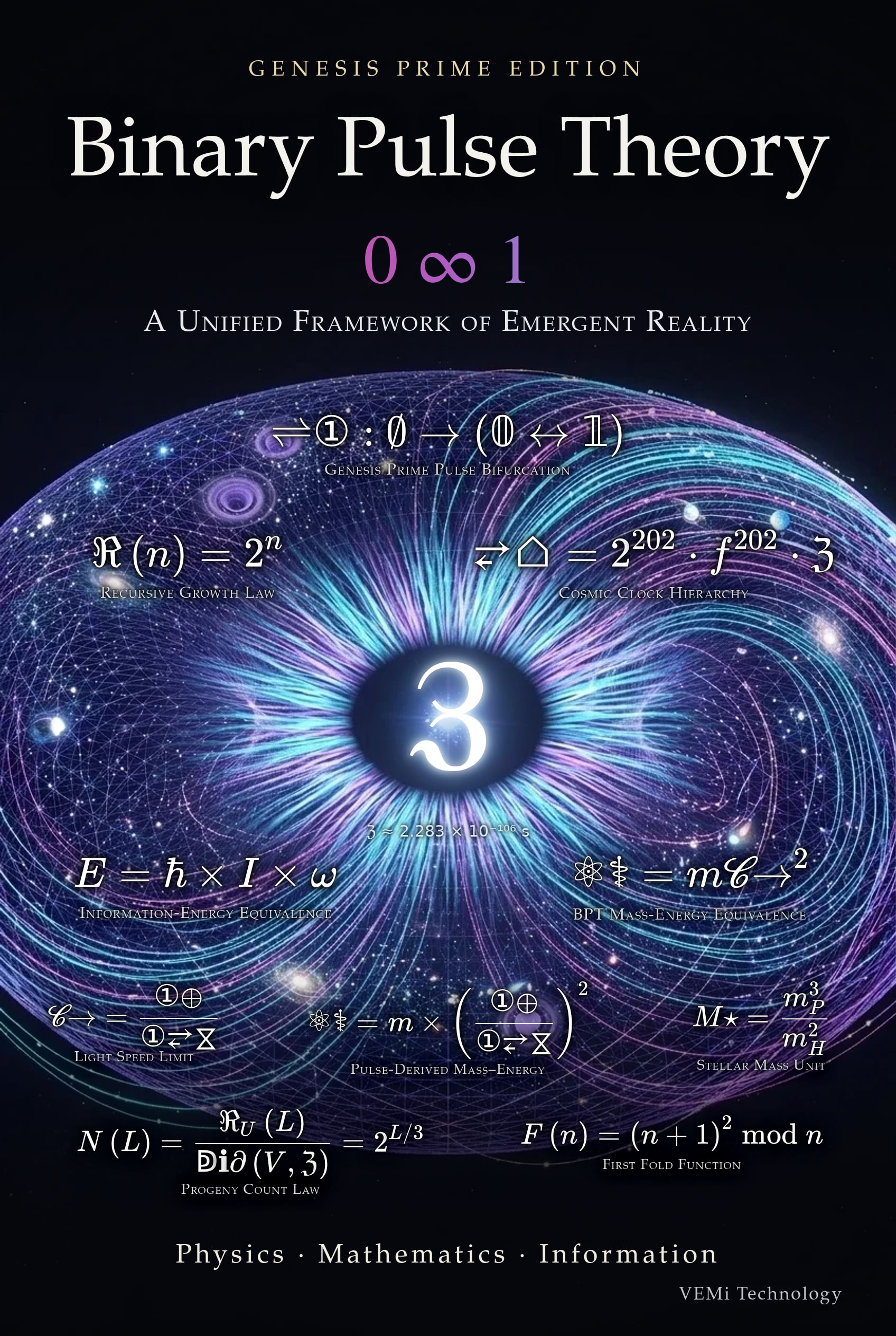
Reality as the consequence of a single recursive transition, 0 to 1. Across nine chapters, Binary Pulse Theory builds from that first pulse to the Zinf and the Pulse Tempo, to Null Wells, density and mass, the Data Nova and the expansion of the universe, dimensionality and harmonics, entropy and renewal, and the quantum threshold. Every law is stated as an equation, checked dimensionally, and tied to a simulation you can run.
-
What if Planck time isn't fundamental? For over a century, physics has treated Planck time as the base of temporal measure — but Binary Pulse Theory reverses this assumption, r...
- 1 The Binary Foundation of Our Reality
- 2 The Computational-Physical Bridge: Data-Rhythm vs Physical-Rate Architecture
- 3 From Nothing to Pulse Diameter: The First Geometry of Space
- 4 The Foundation of Computational Sequences
- 5 The Foundational Equation and Structural Growth
- 6 The Zinf ℨ Unit and Measurable Genesis
- 7 The Zinfinity ℨ∞ Constant and UniSpheral Foundations
- 8 The Zinf ℨ Quantum - Reality's Pixel
- 9 The UniSpheral Grid - All Realities Unified
- 10 Pulse Phase Temporal Genesis and Directional Operations
- 11 Pulse Diameter, Data Gravity and The Speed of Light
- 12 Mathematical Genesis and Recursive Law
- 13 The First Recursive Loop
- 14 Recursive Amplification and Dimensional Genesis
- 15 Pulse Feedback Dynamics and Emergent Order
- 16 The 202 Nexus
-
What if the Universe's greatest mystery isn't how things begin, but how they end — and begin again? What if cosmic collapse isn't cosmic death but cosmic rebirth? Binary Pulse T...
- 1 The Zero Substrate and Absolute Foundation
- 2 The Pulse and Null Wells
- 3 Null Wells (Black Holes) and the Birth of New Universes
- 4 Event Horizons and Null Wells
- 5 Density and the Relative Pulse (Planck) Constant
- 6 Null Mass and Recursive Genesis
- 7 The Null Well: Collapse as Creation
- 8 Pulse Diameter Variability and Merger-Origin Dynamics
- 9 Gas, Stars, and the Stellar Road to the Null Well
- 10 The Strong Force and the Mass of Matter
- 11 Nuclei and the Making of the Elements
- 12 Charge, Electrons, and Chemistry
-
What if the most fundamental question in physics — how does abstract computation become tangible reality — has been hiding in plain sight? Having established the dimensional arc...
- 1 From Binary Transition to Physical Energy — The UniSpheral Data Spectrum
- 2 Pulse Radius, The First Fold, and Recursive Constraints
- 3 The Integral of Recursion — Solving for the Data Nova
- 4 Cosmic Pulse Frame Rate, and the Threshold of Creation
- 5 Calculating the Scale of a Data Nova
- 6 Data Novas and Dimensional Evolution
- 7 The Pulse Convergence and the True Big Bang
- 8 The Ignition Loop — When Recursion Triggers the Bang
- 9 Fractal Progeny — Recursive Universe Instantiation via Null Collapse
- 10 Silent Wells and the Return to the Source
- 11 The Expansion of the Physical Universe
- 12 Ripples, Spin, and the Whirling Disks
- 13 The Dark Sector: Data Matter, the Null Vacuum, and Vacuum Pressure
- 14 Galaxies: the Wells and the Stars Around Them
- 15 The Physical as Executed Code
- 16 The Inherited Compiler
- 17 Two Horizons: How the Halves of a Pulse Go Home
-
What if everything we know about spatial dimensions is backwards? For over a century, physics has treated dimensionality as a fixed backdrop — three spatial dimensions plus time...
- 1 How Dimensions Grow Through Pulse Accumulation
- 2 Dimensional Interaction Layers — The Layered Fabric of Dimensionality
- 3 The Architecture of Dimensional Layers
- 4 The Great Bifurcation — Nova Within vs. Nova Without
- 5 True Expansion — Nova Containment and Dimensional Folds
- 6 The Alpha String Harmonic Ladder
- 7 The Harmonic Fold and Universal Lattice
- 8 Prime Harmonics and the Dimensions
- 9 The Note of a Universe
- 10 The Language of a Universe
-
What if the deepest questions of consciousness, life, and cosmic evolution could be approached by treating reality itself as a vast binary computer? Binary Pulse Theory proposes...
-
The mathematics behind the Null Well: Planck pulse architecture, density-modified constants, the Null Mass integral, boundary encoding at the computational event horizon, and the compression factor for merger-origin universes.
- 1 Quintuple Nullity and the Null-Preserving Operation
- 2 The Planck Pulse and Null Wells
- 3 Null Wells and the Birth of New Universes
- 4 The Computational Event Horizon and Boundary Information Flow
- 5 Density and the Relative Planck Constant
- 6 The Null Mass Integral and Recursive Capacity
- 7 Collapse Formalism: Null Density and the Genesis Transition
- 8 The Merger Compression Factor and PD Variability
- 9 Spin Inheritance and the Progenitor Axis
- 10 Stellar Formalism: The Gas, the Stellar Mass Unit, and the Stellar Null Well
-
How many pulses act together: the harmonic spectrum, interference as substrate echoes, temporal drag, the resonant field, and the thresholds where the field becomes form.
-
What if the Technological Singularity (G) isn't about faster computers, but about achieving perfect synchronization with the Universe's fundamental Pulse? Binary Pulse Theory re...
- 1 Redefining the Singularity as Recursive Signal Alignment
- 2 The Qubit Threshold and Pulse Geometry
- 3 Qubit Thresholds and the Timeline to Singularity
- 4 What Counts as a Qubit - The PulseCore Definition
- 5 Planck-Limit Resolution and the Initial Pulse Constraint
- 6 Pattern Recurrence in the Bit Curve and Quantum Scaling
- 7 Toroidal Pulse Manifold and Zinf-Limit Universe
- 8 The Zinf-Limit Toroidal Universe
-
Binary Pulse Theory proposes a Universe where information represents the primary substrate from which matter and energy arise — a view that addresses physics' greatest puzzles...
- 1 Dark Matter — Computational Resolution Failures
- 2 Temporal Resolution — Density-Dependent Time
- 3 Cosmic DNA — Parametric Inheritance Across Universe Generations
- 4 Why Something Rather Than Nothing
- 5 Beyond Light Speed — Phase Modulation Navigation
- 6 The Genesis Mechanism — Symmetry Breaking as Recursive Overflow (G)
- 7 The Deepest Foundation — Pre-Pulse Field Information Architecture
- 8 π as the Geometric Heart of Binary Computation
- 9 The Ignition Moment — When Potential Becomes Reality
Book: PulseCore Methodology
-
Applying Binary Pulse Theory. How the PulseCore game computes and shows the theory, law by law, with every formula, every source and every fixed number written down.
- 2 Concordance: Binary Pulse Theory in the Game Every Part of Binary Pulse Theory, and where the game computes it, shows it, or leaves it out.
- 160 Sources Every work cited in PulseCore Methodology, chapter by chapter.
- 0 Glossary generated Every term the book defines, with the section that introduces it.
- 625 Notation generated The symbols and glyphs of the theory, with their dimensions.
-
How the game brings Binary Pulse Theory's universe-from-one-number into play. The level L, the genesis and the lineage set the clock, the constants, the field, the rupture, the progeny and the generations; this chapter shows how the code computes each law, how the player sees it, and where the game and the theory part.
- 1 One Number and Its Four Readings
- 2 Our Universe's Anchor Values
- 3 The Universal Scaling Factor and the Zinf Units
- 4 The Level and Lineage Clock and the Constants of a Universe
- 5 Spin and Compression at Genesis
- 6 Bits per Pulse and the Energy of a Transition
- 7 The Rupture Rule and the Layer Count Law
- 8 The Local Pixel Count, the Field and the Holographic Pixel Bound
- 9 The Progeny Count Law
- 10 The Scale Model: MODEL_LEVEL and Lm
- 11 Choosing a Level: the Panel, the Readouts and the Defaults
- 12 Children at the Final Well
- 13 Level from Share, Ascendant Wells, Dead Ends and the Generations
- 14 The Universe Packet
- 15 Where the Numbers Stop: the Float Range
- 16 The Nova Set, the Layers, Nova Classes and Rarity
-
How the game brings Binary Pulse Theory's Pulsecore to the screen: the field of cells it is written on, the cell rule and clock that run it, the data within and its two novas, the harmonic series of the life, and the horn torus the data then circulates round, each law with the game's arithmetic, what the player sees, and every fixed number it uses.
- 1 The Field and Its Size
- 2 The Cell Rule
- 3 The Clock: Flips, Pulses and Tempos
- 4 The Bifold's Capacity and the Data Within
- 5 The Pulsecore as a Bubble of Data
- 6 The Two Pulsecore Novas and the Inside-Out Turn
- 7 The Harmonics and the Order of the Novas
- 8 Folds, Fold Wells and Failed Proto Wells on the Field
- 9 The Horn Torus and the Equal-Area Map
- 10 Data Flow and the Drag Profile
- 11 Dilation Toward the Final Well
- 12 Retired Couplings: Spin Weights and the Flat-Map Drag
- 13 Instruments of the Field: the Capacity Bar, the Step-Back History, the Nova Record
-
How Binary Pulse Theory's wells live in PulseCore: where the data makes its Proto Wells, how they fail or become sites, how wells are born by collapse, spin, merge, feed, spiral matter in, are ranked by the census and seed their children, and how their rings meet. Each law is set beside the code that computes it and the screen that shows it.
- 1 The Life of a Well, an Overview
- 2 The Formation Condition at Full Scale: densestPeaks()
- 3 The Formation Condition in a Scale Model: protoDrawn(), densePlaces(), wellMult
- 4 Well Masses at the Data Nova, and the Null Well Collapse
- 5 Proto Wells and the Life Record: registerWells(), wellLives
- 6 Failed Proto Wells: failProtoWells()
- 7 Proto Wells Become Sites, and How a Site Fills
- 8 Wells by Collapse: the Hoop Test, Fold Wells and Nova Wells
- 9 Well Spin and the Thorne Limit
- 10 Wells That Meet: mergeWells()
- 11 The Data Around a Well: stepWells()
- 12 Wells and Sites in the Gravity Grid: binWells, nPull, wellsNear and the P³M Switch
- 13 The Inspiral: Matter Spiraling In
- 14 Ascendant Wells and the Census
- 15 The Dive: promptDive(), diveAt(), pickWellFromScene()
- 16 Gravity Rings: RingField and the Adaptive Ring Search
-
How the game brings Binary Pulse Theory's physical universe to life, from the Physical Nova to the cosmic web: the matter the Pulsecore sends out, the universe's own gravity and expansion, the first ripples, the Data Matter, gas that cools into whirling disks, wells that eat matter and drain data, and the heat that decides which clumps become galaxies; for each, the law, the game's math and what the player sees.
- 1 The Matter Layer and Its Order of Work
- 2 The Speed of Light on the Torus
- 3 The Universe's Gravity
- 4 The Expansion of the Physical Universe
- 5 Sending Out Matter at the Physical Nova
- 6 The Zel'dovich Start
- 7 Gravity on the Mesh
- 8 The Direct Pull and the Particle–Particle Split
- 9 Dynamical Friction
- 10 The Dark Sector on the Mesh
- 11 Gas That Cools Keeps Its Spin
- 12 Falls, Mergers, New Wells and Planets
- 13 Wells as Drains of Data
- 14 The Heat of the Universe
- 15 The Scale Model of Matter
- 16 The Matter Step: Timing and Its Own Thread
-
How Binary Pulse Theory's stars come into the game: whether a level can hold matter and stars, the game's Sun, star formation by the Gas Depletion Law, birth masses from the Initial Mass Function, lives and ends by mass, metals, winds, feedback and the Stellar Null Wells, each shown as the code computes it and as the player sees it.
- 1 The Stars in the Matter Step
- 2 The Matter of a Level
- 3 The Game's Sun and What Each Drawn Star Stands For
- 4 The Star Types
- 5 The Initial Mass Function
- 6 Lifetimes, Luminosity and the Giant Phase
- 7 Where Stars Form: the Gas Depletion Law
- 8 Drawing the Stars in Lots
- 9 How Stars End
- 10 Metals
- 11 Winds
- 12 Feedback
- 13 Stellar Null Wells
- 14 Star Tallies, Readouts and Well-Life Samples
-
How the game brings Binary Pulse Theory's galaxies to life. Each well gathers its own stars, the galaxy's type, disk, arms, size and turning are read by the book's laws from what the simulation measures, the sites of the Proto Wells are scored against where wells are born, and the player watches the galaxies turn and the streams fall in along the web.
- 1 From a Field of Bodies to Galaxies
- 2 Whose Stars Are Whose: the Galaxy Index
- 3 Reading a Galaxy's Type
- 4 The Disk Measured: Rotation Curve, Shear, Arms and Pitch
- 5 How Big a Galaxy Is, and How Big It Is Drawn
- 6 The Reading Cycle and How Fast a Disk Turns
- 7 Sites, Their Sizes, and the Site Lift
- 8 Drawing a Galaxy: Its Points, Its Layout, Its Light
- 9 Streams Along the Filaments
- 10 The Web on the Field: Cluster Glows, Swirls, Patches and Voids
-
How the game brings Binary Pulse Theory's time crystals, strings, interference, phase-locked domains and the language of a universe out of its own field: what the theory says, how the game computes it, what the player sees, and how faithfully.
- 1 Reading the Field Back
- 2 The State Watch: Recording and the Period Test
- 3 Beats: Time Crystals, Breathers and Oscillons
- 4 Order in Space: Lattices, Néel Crystals, Stripes, Wigner and Space-Time Crystals
- 5 Domain Walls and Quasicrystals
- 6 Solitons, the Unclassified State and Revivals
- 7 Species, Announcement, the Discovery Card and the Worker
- 8 Harmonic Nodes Are Not Time Crystals
- 9 Strings
- 10 The Language Reader: Alphabet, Words and the Drive
- 11 The Three Tests: Zipf, the Monkey and Predictability
- 12 The Control and the Verdict
- 13 Codebook, Dialect, Cognates, Fingerprint and the Language Block
- 14 The Collection, the Notices and the Saved Records
-
How the game makes Binary Pulse Theory visible: the universe as the skin of a torus, the lattice the data lays, the Pulsecore and the space it expels, the novas and the big bang, the wells and Proto Wells, matter as stars, the camera and the time between steps, choosing a well, the 2D field, the readouts and banners, and the note a universe sounds.
- 1 The Torus and Its Skin
- 2 The Lattice of the Level
- 3 The Pulsecore and the Space Layer
- 4 The Novas Drawn: Eruption, Pin Head, Big Bang, First Light and Fade
- 5 Wells Drawn
- 6 The Proto Layer
- 7 Matter as Stars
- 8 How Many Points Are Drawn
- 9 Time Between Steps and the Camera
- 10 Picking and the Pointer
- 11 Crystals and Strings Drawn
- 12 The 2D Field
- 13 The Readouts, Banners and Toasts
- 14 Sound
-
How the game fits a universe far too large to compute onto a phone or a desktop and keeps it the same universe: the scale model, the Saturation Law, measuring the device, the kinds of fixed number, where the game and the theory differ, and how the game is tested.
- 1 The Scale Model: What Each Drawn Thing Stands For
- 2 The Saturation Law
- 3 Measuring the Device
- 4 Fixed Numbers and Their Kinds
- 5 Where the Game and the Theory Differ
- 6 Bringing the Game to the Theory
- 7 The Constants That Stay
- 8 The Register of Caps
- 9 The Register of Record Limits
- 10 How the Game Is Tested
-
The whole of a run of Alpha v8.4, step by step from the page loading to the end of the universe and the start of the next, each step in plain words with the code that does it.
- 1 The Page Loads
- 2 The Player Sets the Genesis
- 3 Start
- 4 Every Flip: The Cell Rule
- 5 The Pulsecore Fills
- 6 Harmonic 1, the Null Nova: Space Is Born
- 7 Harmonic 2, the Data Nova: The Data Erupts
- 8 Every Step of the Universe's Life
- 9 Harmonic 3, the Physical Nova: The Big Bang
- 10 The Harmonics
- 11 The Final Well
- 12 Return to the Source
- 13 The Dive: A Child Universe
- 14 The Full Decay
- 15 Level 0: The Zinf Beats Again
- 16 The Whole Script on One Page
Book: Quantum Pulse Theory
-
Coming soon. Where the binary pulse meets the quantum — the second book, written on the foundation the first one laid.