Chapter 1 · Section 8
The Zinf ℨ Quantum - Reality's Pixel
Prepare for the most mind-bending revelation in physics: Reality isn't continuous — it's pixelated like a cosmic video game. The Zinf ℨ Quantum discovery identifies the fundamental "atom of time" that explains why all physical constants have their precise values. In BPT, it is the computational unit underlying all existence.
The Zinf ℨ addresses one of the deepest questions in physics: why do fundamental constants have their specific values? BPT's answer: they're harmonics at Level 202 of infinite recursive architecture operating from the original first Universe: every Planck value is set by a universe's level and its parent black hole's singularity. We're not living in a randomly configured Universe — we're operating at a specific computational zoom level derived from cosmic code running ≈ 10⁶² times faster than our reality.
The Zinf ℨ Pixel Quantum and Recursive Relation
The Zinf ℨ Pixel Quantum is derived by comparing the Pulse Tempo interval of our Local Universe to the far deeper computational scale inherited from the original Genesis Prime Pulse Universe (The UniSphere). One Local Pulse time (⥂ ≈ 5.39 × 10⁻⁴⁴ s) contains ≈ 2.36 × 10⁶² whole Zinf-scale cycles. This ratio reveals the Zinf ℨ interval as the primordial pixel of time.
Zinf ℨ Pixel Quantum Recursive Relation G
ℨ = ⥂⌂ / Nℨ
Dimensional analysis:
Where (from the book): ℨ [ℨ]
[ℨ]
[𝕋] ÷ [∅] = [𝕋]
[ℨ] = [𝕋] ✓ Valid PulseCore Verified ✓
The Zinf quantum emerges as the fundamental subdivision of Pulse Rate.
Where:
- ℨ [ℨ] – Zinf Quantum Unit; fundamental temporal atom representing the smallest computable duration
- ⥂⌂ [𝕋] – Local Pulse Tempo; complete computational cycle ≈ 5.39 × 10⁻⁴⁴ s
- Nℨ [∅] – count of Zinf operations per Pulse Tempo; computational ticks within one Pulse cycle ≈ 2.36 × 10⁶²
➢ The Zinf ℨ Quantum emerges as the fundamental subdivision of Pulse time, representing the ≈ 2.36 × 10⁶² whole computational ticks that occur within each Pulse interval, revealing the ultra-fine temporal granularity of the computational substrate underlying physical reality.
Zinf ℨ Pixel Quantum Numerical Evaluation G
ℨ = (5.391 × 10⁻⁴⁴ s) / (2²⁰² · f²⁰²)
Dimensional analysis:
[ℨ]
([∅] × [∅] × [∅]) ÷ ([∅] × [∅]) = ([∅] × [∅]) ÷ ([∅] × [∅]) = [∅] ÷ ([∅] × [∅]) = [∅] ÷ [∅] = [∅]
[ℨ] = [∅] ✓ Valid PulseCore Verified ✓
ℨ ≈ 2.283 × 10⁻¹⁰⁶ seconds
Numerical calculation of the fundamental Zinf quantum from Pulse Tempo subdivision.
Where:
- ℨ [ℨ] – Zinf Quantum Unit; fundamental temporal atom
- 5.39 × 10⁻⁴⁴ s [𝕋] – Pulse Tempo numerical value
- 2²⁰² × f²⁰² [∅] – count of whole Zinf cycles per Pulse Tempo interval (≈ 2.361 × 10⁶²)
- 2.283 × 10⁻¹⁰⁶ [𝕋] – calculated Zinf Quantum magnitude
➢ The numerical evaluation reveals the Zinf ℨ Quantum as the temporal atom about 62 orders of magnitude smaller than Planck time, establishing the ultra-fine computational granularity where individual binary operations occur in the fundamental substrate of reality.
Zinf ℨ Pixel Quantum G
ℨ ≈ 2.283 × 10⁻¹⁰⁶ seconds
The fundamental Time quantum representing the UniSphere's primordial computational tick.
Where:
- ℨ [ℨ] – Zinf Quantum Unit (the UniSphere's full pulse unit, 0 → 1 → 0; its data rhythm is ↁℨ⧖ = ℨ/2 ≈ 1.142 × 10⁻¹⁰⁶ s)
- 2.283 × 10⁻¹⁰⁶ [𝕋] – magnitude of the temporal interval in seconds
➢ This isn't just another small number — it's the original Universe's clock cycle from which all time emerges. The Zinf ℨ represents the full Pulse Tempo, the first viable full completion 0 → 1 → 0, of the first successful computation of a Universe that escaped collapse into nothingness, establishing the primordial beat that generates all subsequent temporal frameworks including our Planck time.
The establishment of the Zinf ℨ Pixel Quantum anchors time itself to a computable substrate. By showing that each Planck interval contains ≈ 2.36 × 10⁶² whole Zinf ℨ ticks, Binary Pulse Theory reveals that what we perceive as continuous time is in fact the aggregation of vast numbers of deeper binary oscillations. This closure makes the Zinf ℨ not just a number, but the fundamental “pixel clock” of reality — the primordial rhythm that underlies every constant, every law, and every emergent phenomenon in the Universe.
The Hierarchical Clock Architecture of the UniSphere
Time in our Universe does not exist in isolation — it is one layer of a larger recursive clock system. Beneath the familiar Pulse Time interval lies the Zinf cycle, a far deeper tick inherited from the Genesis UniSphere. By situating Pulse Tempo within this hierarchy, Binary Pulse Theory reveals that our constants and laws are not arbitrary, but the outcome of harmonic scaling from a primordial computational rhythm.
Our Local Universe operates at Pulse Tempo (⥂ ≈ 5.39 × 10⁻⁴⁴ seconds), but this emerges as a slower derivative of the ≈ 10⁶² times faster Zinf ℨ cycle from the original Universe.
UniSphere Cosmic Clock Hierarchy G
⥂⌂ = 2²⁰² · f²⁰² · ℨ
Dimensional analysis:
Where (from the book): 2²⁰² [∅], ℨ [ℨ]
[𝕋]
[∅] × [∅] × [ℨ] = [∅] × [ℨ] = [ℨ]
[𝕋] = [ℨ] ✓ Valid PulseCore Verified ✓
Original Universe → Our Universe Timing Relationship
Where:
- ⥂⌂ [𝕋] – Local Pulse Tempo; temporal quantum at our universe level 202
- 2²⁰² · f²⁰² [∅] – harmonic downscaling factor (f = 1.018 per level), ≈ 2.36 × 10⁶²; mathematical relationship linking primordial to local timing
- ℨ [ℨ] – Zinf Unit; primordial temporal quantum from Genesis UniSphere
➢ The original Universe runs at the Zinf ℨ rate — ≈ 10⁶² times faster than our cosmic clock. Our Planck time represents a harmonically scaled-down version of that primordial computational speed, explaining why our physical constants have their specific values.
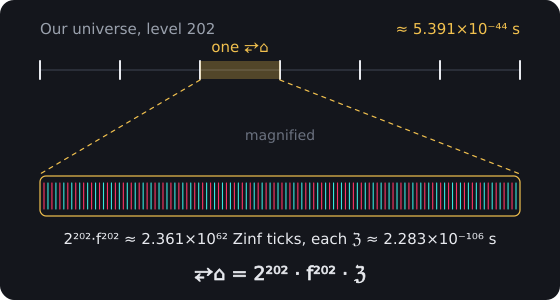
The Cosmic Clock Hierarchy. One tick of our clock, the Pulse Tempo ⥂⌂ ≈ 5.391 × 10⁻⁴⁴ s, holds 2²⁰² · f²⁰² ≈ 2.361 × 10⁶² ticks of the Zinf ℨ ≈ 2.283 × 10⁻¹⁰⁶ s.
The Zinf ℨ Pixel Architecture of Spacetime
Spacetime is not continuous but constructed from indivisible pixels defined at the Zinf scale. Each pixel is both temporal and spatial: a duration ℨ and a length ℓz derived from the UniSphere’s original cadence, one spacetime step, just as a Pulse Diameter and its Rhythm are one step in every universe (Diameter = 𝒞→ × Rhythm). This digital architecture means that every point in space and every tick of time is grounded in a fixed computational unit, forming the lattice upon which all physical law is executed.
🟑UniSphereal Zinf ℨ Pixel Size G
🟑ℨ = κ_z × 𝒞→ × ℨ
Dimensional analysis:
[𝕃]
[∅] × [𝕃·𝕋⁻¹] × [ℨ] = [𝕃·𝕋⁻¹] × [ℨ] = [ℨ·𝕃·𝕋⁻¹]
[𝕃] = [ℨ·𝕃·𝕋⁻¹] ✓ Valid PulseCore Verified ✓
Fundamental spatial pixel derived from temporal quantum and light speed coupling.
Where:
- 🟑ℨ is fundamental spatial pixel size (reality's resolution limit)
- κ_z is Zinf coupling constant (reality's aspect ratio)
- 𝒞→ is speed of light (the speed limit for every physical thing, light included; data steps faster, one local Pulse Diameter per Zinf Rhythm)
- ℨ is Zinf Unit (temporal pixel duration from original Universe)
➢ Every point in space corresponds to exactly one Zinf ℨ pixel derived from the original Universe's computational architecture. Reality operates like a vast 3D display with fixed pixel size determined by the primordial Zinf ℨ timing, revealing the Universe as fundamentally digital rather than analog.
In this view, Planck time is not the deepest boundary but a derivative timing tier within a cosmic hierarchy of clocks. The Zinf ℨ cycle sets the foundational beat, while our Local Universe’s slower Planck interval represents a harmonically downscaled expression of that primordial cadence. This recursive structure explains why physical constants hold their exact values: they are the resonant harmonics of the UniSphere’s original clock.
Each Zinf-scale element represents the fundamental pixel size of computational fabric, while our Universe's frame rate operates at Planck time.
UniSphereal Binary Pixel States G
|0⟩ ↔ |1⟩ at ℨ scale
Fundamental Computational Units
Where:
- |0⟩ is Zinf-pixel inactive state (computational zero)
- |1⟩ is Zinf-pixel active state (computational one)
- ℨ is Zinf Unit scale ≈ 2.283 × 10⁻¹⁰⁶ seconds (fundamental pixel size)
- ↔ indicates binary state alternation at Zinf resolution
➢ The fundamental computational units of reality operate as binary pixels at the Zinf scale, where each pixel alternates between inactive and active states at the most fundamental temporal resolution, forming the discrete computational substrate underlying all physical phenomena.
Computational Architecture
State |0⟩ G
Zinf-pixel inactive
Computational zero
State |1⟩ G
Zinf-pixel active
Computational one
UniSphereal Pixel Size G
ℨ ≈ 2.283 × 10⁻¹⁰⁶ seconds
Fundamental computational grain
Local Frame Rate G
1/⥂⌂ ≈ 1.855 × 10⁴³ Hz
Pulse Tempo refresh frequency
Where:
- |0⟩ [∅] – Zinf-pixel inactive state; computational zero
- |1⟩ [∅] – Zinf-pixel active state; computational one
- ℨ [ℨ] – Zinf Unit scale ≈ 2.283 × 10⁻¹⁰⁶ seconds; fundamental pixel size
- ↔ [∅] – binary state alternation at Zinf resolution
- 1/⥂⌂ [𝕋⁻¹] – Local frame rate ≈ 1.855 × 10⁴³ Hz; Pulse Tempo refresh frequency
➢ Reality is constructed from Zinf-scale computational pixels inherited from the original Universe, but our Universe processes these pixels at the much slower Planck time frame rate. Each Planck interval aggregates vast numbers of Zinf-scale 0-1 operations, creating emergent physical phenomena from fundamental binary computational fabric operating at inherited primordial resolution.
In this architecture, reality is revealed as a binary display: Zinf pixels toggling between inactive and active states at unimaginable speed, aggregated into Planck-scale frames that give rise to the appearance of continuity. By grounding both space and time in Zinf-derived pixels, Binary Pulse Theory shows that our Universe is not analog but discretized, with physical constants and emergent phenomena arising from the recursive processing of the UniSphere’s primordial pixel grid.
The UniSphereal Computational Fabric
Beneath the apparent continuity of spacetime lies a hidden substrate: strings of Zinf-scale binary operations that form the active machine code of the Universe. These operations did not end with the Genesis UniSphere — they remain ongoing, constructing every particle, field, and law we observe. Our Universe is thus not built on matter or energy as primitives, but on the recursive aggregation of Zinf-scale 0–1 strings.
Zinf-scale 0-1 strings aren't just historical artifacts from the original Universe — they're the active computational fabric underlying all reality. These infinitely tiny binary operations from the prime Pulse Universe continue operating within our Universe as the fundamental substrate from which everything emerges.
UniSpheral Substrate Computational Architecture G
Our Reality = Aggregate (Zinf-scale 0-1 strings)
Computational Density Relationship G
Nℨ = (⥂⌂ / ℨ) ≈ 2.36 × 10⁶² per Pulse
Count of Zinf operations within one Pulse Tempo cycle.
Where:
- Nℨ [∅] – count of Zinf operations per Pulse Tempo interval within computational substrate
- ⥂⌂ [𝕋] – Local Pulse Tempo; complete computational cycle of local universe timing
- ℨ [ℨ] – Zinf Unit; primordial temporal quantum from Genesis UniSphere
- 2.36 × 10⁶² [∅] – approximate numerical value of computational density
➢ This reveals why quantum mechanics appears probabilistic — we're seeing statistical averages of vast numbers of deterministic Zinf-scale binary operations. This is how Binary Pulse Theory meets Bell's theorem (Bell, 1964), whose loophole-free tests (Hensen et al., 2015; Giustina et al., 2015; Shalm et al., 2015) leave no room for local hidden variables carrying correlations across space. None do here: the substrate is local, the data flowing all around and looping back to its source, and entangled correlations run through the shared loop — the UniSphere and the Zinf every bit passes through — not across space. No message can be sent faster than light, because each observer's result looks random until the results are compared by ordinary means.
The Zinf strings are the "machine code" that everything runs on. Our particles, forces, and spacetime are emergent properties arising from the collective behavior of these fundamental 0-1 operations that originated in the prime Pulse Universe but continue as the active computational substrate of all existence.
In this light, the UniSpheral Computational Fabric is revealed as a hierarchy of ticks: Planck intervals are frames, each containing ≈ 2.36 × 10⁶² whole Zinf-scale binary cycles. What quantum mechanics presents as probability is in fact the statistical surface of deterministic Zinf operations running at a far deeper rate. The fabric of reality is therefore nothing less than the persistent, recursive activity of the UniSphere’s primordial code — a substrate that continues to compute existence itself.
The Data Bit — Reality’s Informational Atom
The UniSpheral substrate is built not from abstract mathematics but from discrete informational atoms. Each half-cycle of the Pulse (⧖) crystallizes one Data Bit (▣), recording the binary resolution of the oscillation at pole 0 or pole 1. In this way, every Time Crystal contributes not only energy and memory but also an indivisible unit of information.
ↁ▣ Data Bit Definition G
ↁ▣ = {0, 1}
Fundamental information quantum crystallized from binary transitions.
Where:
- ↁ▣ [∅] – Data Bit; fundamental information quantum generated by binary state transitions
- ↁ [∅] – Data namespace indicator; marks entity as part of Data layer
- ▣ [∅] – bit symbol; discrete informational atom
- {0, 1} [∅] – binary value set; possible states that can be crystallized during transitions
- 0 [∅] – inactive binary state; ground condition in oscillation sequence
- 1 [∅] – active binary state; activated condition enabling information processing
➢ Each Data Bit represents the crystallized informational content of a single binary transition, where Time Crystal formation (⧖) simultaneously generates both temporal structure and discrete information quanta, establishing the fundamental equivalence between computational processes and physical information atoms in the substrate architecture. Every Pulse cycle (①⥂) deposits two bits (▣▣) — one on the outward stroke (0→1) and one on the return stroke (1→0).
Data-Energy Equivalence
The Zinf framework not only reveals the pixel architecture of spacetime but also proposes that information itself is physical: data builds everything, and when we look at atoms we are seeing physical data. Each Zinf Rhythm ↁℨ⧖ encodes one bit of activity (two per Zinf cycle ℨ), and each cycle contributes to measurable energy. From this foundation emerge two of the most profound principles: the equivalence of information and energy, and the universal speed limit of light as a computational constraint. The Zinf framework holds that information has measurable mass-energy, with consequences for physics and technology.
ↁρ UniSpheral Data Density Definition G
ↁρ = ↁ▣ per 🟑ℨ³ per ↁℨ⧖
The Digital Foundation
Where:
- ↁρ [𝕃⁻³·𝕋⁻¹] – Data Density; information processing capacity per unit volume per time
- ↁ▣ [∅] – Data Bit; fundamental information quantum crystallized from binary transitions
- 🟑ℨ³ [𝕃³] – fundamental spatial volume element based on Zinf pixel architecture
- ↁℨ⧖ [ℨ] – Zinf Rhythm, ℨ/2 ≈ 1.142 × 10⁻¹⁰⁶ s; one Data Bit per Zinf Rhythm, two per Zinf cycle ℨ
➢ Each spatial pixel processes exactly one Data Bit per Zinf Rhythm ↁℨ⧖ (two per Zinf cycle ℨ) based on the original Universe's Zinf timing, establishing the fundamental information processing capacity of reality. This indicates that information isn't abstract — it's the energetic substance from which matter and energy emerge.
Data Energy + Power
The Universe and The UniSphere
UniSphereal Data Energy G
ↁ⚕☫ = (ↁ⚕⌂ × ⥂⌂) / ℨ
Dimensional analysis:
Where (from the book): ↁ⚕☫ [𝕄·𝕃²·𝕋⁻²], ↁ⚕⌂ [𝕄·𝕃²·𝕋⁻²], ℨ [ℨ]
[𝕄·𝕃²·𝕋⁻²]
([𝕄·𝕃²·𝕋⁻²] × [𝕋]) ÷ [ℨ] = [𝕄·𝕃²·𝕋⁻¹] ÷ [ℨ] = [ℨ⁻¹·𝕄·𝕃²·𝕋⁻¹]
[𝕄·𝕃²·𝕋⁻²] = [ℨ⁻¹·𝕄·𝕃²·𝕋⁻¹] ✓ Valid PulseCore Verified ✓
Energy per successful closure at the UniSphereal level
Where:
- ↁ⚕☫ [𝕄·𝕃²·𝕋⁻²] – UniSphereal Data Energy; fundamental energy quantum for computational closure operations
- ↁ⚕⌂ [𝕄·𝕃²·𝕋⁻²] – Local Data Energy; energy per computational closure at our universe level
- ⥂⌂ [𝕋] – Local Pulse Rate; complete binary cycle duration at our harmonic level
- ℨ [ℨ] – Zinf Unit; fundamental temporal atom and computational duration quantum
➢ The primordial energy quantum at the UniSphereal level expressed entirely in BPT fundamentals, eliminating the need for the Planck constant by deriving energy relationships directly from computational substrate architecture through Data Energy, Pulse Rate, and Zinf scaling.
Local Universe Data Energy G
ↁ⚕⌂ = (ↁ⚕☫ × ℨ) / ⥂⌂
Dimensional analysis:
Where (from the book): ↁ⚕⌂ [𝕄·𝕃²·𝕋⁻²], ↁ⚕☫ [𝕄·𝕃²·𝕋⁻²], ℨ [ℨ]
[𝕄·𝕃²·𝕋⁻²]
([𝕄·𝕃²·𝕋⁻²] × [ℨ]) ÷ [𝕋] = [ℨ·𝕄·𝕃²·𝕋⁻²] ÷ [𝕋] = [ℨ·𝕄·𝕃²·𝕋⁻³]
[𝕄·𝕃²·𝕋⁻²] = [ℨ·𝕄·𝕃²·𝕋⁻³] ✓ Valid PulseCore Verified ✓
Energy per successful closure
Where:
- ↁ⚕⌂ [𝕄·𝕃²·𝕋⁻²] – Local Data Energy; fundamental energy quantum for computational closure in our universe
- ↁ⚕☫ [𝕄·𝕃²·𝕋⁻²] – UniSphereal Data Energy; primordial energy quantum from computational substrate
- ℨ [ℨ] – Zinf Unit; fundamental temporal atom and computational duration quantum
- ⥂⌂ [𝕋] – Local Pulse Rate; complete binary cycle duration at our harmonic level
➢ Local Data Energy represents the fundamental energy quantum required for successful computational closure at our universe level, scaled down from the primordial energy through the harmonic hierarchy by factor 2²⁰² · f²⁰² ≈ 2.36 × 10⁶², demonstrating how energy constants emerge from computational architecture rather than arbitrary parameters.
Data Power — The Flow of Energy Through Time
If Data Energy (⚕) is the quantum packet released at each closure, then Data Power (♆) is the rate at which those packets are delivered through time. Power represents not a single closure event, but the continuous throughput of oscillation, binding the energy quantum to the rhythm of the Pulse. In this way, Power is the dynamic face of Energy — not what is stored, but what is flowing.
ↁ♆ Local Data Energy Power G
ↁ⚕♆⌂ = ↁ⚕⌂ × (1/⥂⌂)
Dimensional analysis:
Where (from the book): ↁ⚕♆⌂ [𝕄·𝕃²·𝕋⁻³], ↁ⚕⌂ [𝕄·𝕃²·𝕋⁻²], 1/⥂⌂ [𝕋⁻¹]
[𝕄·𝕃²·𝕋⁻³]
[𝕄·𝕃²·𝕋⁻²] × ([𝕋⁻¹]) = [𝕄·𝕃²·𝕋⁻²] × [𝕋⁻¹] = [𝕄·𝕃²·𝕋⁻³]
[𝕄·𝕃²·𝕋⁻³] = [𝕄·𝕃²·𝕋⁻³] ✓ Valid PulseCore Verified ✓
Rate of energy throughput in our universe
Where:
- ↁ⚕♆⌂ [𝕄·𝕃²·𝕋⁻³] – Local Data Energy Power; rate of Data Energy throughput per unit time in our universe
- ↁ⚕⌂ [𝕄·𝕃²·𝕋⁻²] – Local Data Energy; energy quantum per computational closure at our universe level
- 1/⥂⌂ [𝕋⁻¹] – Local Pulse Rate reciprocal; frequency of energy packet delivery
- ⥂⌂ [𝕋] – Local Pulse Rate; complete binary cycle duration at our harmonic level
- ⚕ [∅] – Energy symbol; energy quantum indicator
- ♆ [∅] – Power symbol; rate indicator for energy flow
➢ Data Energy Power represents the dynamic flow of Data Energy through the computational substrate, where each Data Energy quantum is delivered at the rhythm of the Pulse, establishing power as the temporal rate of Data Energy throughput binding quantum packets to oscillatory rhythm.
UniSpheral Data Energy Power G
ↁ⚕♆☫ = ↁ⚕☫ × (1/☫⥂)
Dimensional analysis:
Where (from the book): ↁ⚕♆☫ [𝕄·𝕃²·𝕋⁻³], ↁ⚕☫ [𝕄·𝕃²·𝕋⁻²], 1/☫⥂ [𝕋⁻¹]
[𝕄·𝕃²·𝕋⁻³]
[𝕄·𝕃²·𝕋⁻²] × ([𝕋⁻¹]) = [𝕄·𝕃²·𝕋⁻²] × [𝕋⁻¹] = [𝕄·𝕃²·𝕋⁻³]
[𝕄·𝕃²·𝕋⁻³] = [𝕄·𝕃²·𝕋⁻³] ✓ Valid PulseCore Verified ✓
Fundamental throughput of energy across the UniSphere
Where:
- ↁ⚕♆☫ [𝕄·𝕃²·𝕋⁻³] – UniSphereal Data Energy Power; rate of Data Energy throughput at primordial computational level
- ↁ⚕☫ [𝕄·𝕃²·𝕋⁻²] – UniSphereal Data Energy; fundamental energy quantum for computational closure operations
- 1/☫⥂ [𝕋⁻¹] – UniSphereal Pulse Rate reciprocal; frequency of primordial energy packet delivery
- ☫⥂ [𝕋] – UniSphereal Pulse Rate; the Zinf Tempo, ☫⥂ = ℨ, complete binary cycle duration at primordial level
- ⚕ [∅] – Energy symbol; energy quantum indicator
- ♆ [∅] – Power symbol; rate indicator for energy flow
- ☫ [∅] – UniSphereal level indicator
➢ UniSphereal Data Energy Power represents the fundamental rate of Data Energy flow through the primordial computational substrate, establishing the maximum possible energy throughput at the Zinf scale before harmonic scaling reduces power density at higher universe levels.
Through the lens of Binary Pulse Theory, Energy (⚕) and Power (♆) are not independent constructs but complementary expressions of closure. Energy measures the discrete packet per transition; Power measures the continuous flow across transitions. Both reduce to the same substrate architecture: a Pulse cycle (⥂), its rate (1/⥂), and the Zinf Unit (ℨ). By extending Data Energy into Data Power, the UniSphere reveals itself not just as a store of quanta, but as a perpetual engine of flow — a reality sustained by the ceaseless throughput of the binary heartbeat.
Data Information Capacity
UniSpheral Data Information Capacity G
ↁρₐ = ↁ▣ per 🟑ℨ³ per ↁℨ⧖
Maximum processing rate
Where:
- ↁρₐ [𝕃⁻³·𝕋⁻¹] – Dynamic Data Density; information processing capacity per unit volume per time
- ↁ▣ [∅] – Data Bit; fundamental information quantum crystallized from binary transitions
- 🟑ℨ³ [𝕃³] – fundamental spatial volume element based on Zinf pixel architecture
- ↁℨ⧖ [ℨ] – Zinf Rhythm, ℨ/2 ≈ 1.142 × 10⁻¹⁰⁶ s; one Data Bit per Zinf Rhythm, two per Zinf cycle ℨ
➢ The universe's maximum Data Information processing rate is fundamentally limited by the Zinf Unit temporal quantum, establishing that reality can process at most one Data Bit per Zinf Rhythm ↁℨ⧖ (two per ℨ), defining the computational speed limit of existence itself.
Local Data Information Capacity G
ↁⓘ⥣⌂ = 2²⁰² ↁ▣ / ①⥂⧖⌂ = 2²⁰³ ↁ▣ / (2²⁰² × f²⁰² × ℨ) ≈ 2.38 × 10¹⁰⁴ bits/s
Maximum local information processing rate
Where:
- ↁⓘ⥣⌂ [𝕋⁻¹] – maximum local Data Information processing rate
- ↁⓘ [∅] – Data Information (information content within Data layer)
- ⥣ [∅] – universal maximum indicator
- ⌂ [∅] – local level indicator
- ↁ▣ [∅] – Data Bit; fundamental information quantum
- ⥂⌂ [𝕋] – Local Pulse Rate; complete binary cycle duration at harmonic level 202
- 2²⁰² [∅] – Data Bits per local Rhythm; data doubles exactly per level from the single bit of the Zinf Rhythm
- 2²⁰² × f²⁰² [∅] – harmonic scaling factor at level 202
- ℨ [ℨ] – Zinf Unit; fundamental temporal atom and scaling foundation
➢ Data doubles exactly per level, so at our local universe level 202 each Rhythm carries 2²⁰² Data Bits and one Planck cycle carries 2²⁰³ ≈ 1.29 × 10⁶¹; the single bit exists only in the Zinf universe. Time stretches by 2f per level while data only doubles, so local reality processes information below the Zinf's 2/ℨ ≈ 8.76 × 10¹⁰⁵ bits per second by the null-well heritage f²⁰² ≈ 36.7.
These constants aren't mysteriously given — they emerge from ℨ-based computational architecture. This reframes fine-tuning: we observe these values because they are the ones Level 202 carries, and that level is set by the Rupture Rule, not chosen for observers.
1.8 Testable Predictions
- Zinf Synchronization Discovery: Atomic clocks reveal synchronization limits at ℨ ≈ 2.283 × 10⁻¹⁰⁶ seconds, detectable through quantum tunneling analysis. Success would support reality's digital clock cycle derived from the original Universe.
- Harmonic Constant Relationships: Physical constants follow harmonic scaling ①⥂⧖(N) = 2ᴺ · fᴺ · ℨ / 2 from the original Universe, verifiable through precision measurements. Success validates the recursive architecture connecting our reality to primordial timing.
- Cosmic Pixel Signatures: CMB shows anisotropies at ℨ scales with harmonic periodicity inherited from original Universe timing, detectable through ultra-precision analysis. Success reveals the pixelated foundation of spacetime.
- Computational Processing Limits: Quantum computers encounter fundamental limits at 1 bit per Zinf Rhythm ↁℨ⧖ (2 per ℨ) rate based on original Universe constraints, testable through algorithm optimization. Success would support the computational nature of physical reality derived from primordial architecture.
These discoveries will enable technologies based on reality's computational structure potentially including information-based energy generation, digital manipulation of spacetime, and computing systems that operate at cosmic frame rates inherited from the original Universe's ≈ 10⁶² times faster computational cycles.