Chapter 9 · Section 3
Cosmic DNA — Parametric Inheritance Across Universe Generations
Physical Constants Evolve Across Cosmic Generations
How does the fundamental binary computational substrate propagate across multiple cosmic generations while maintaining causal consistency and enabling evolutionary complexity growth? Binary Pulse Theory establishes Prime Pulse Bifurcation ∅ → (0 ↔ 1) as the invariant computational quantum underlying all physical reality, yet its parametric manifestation exhibits systematic variation defining unique characteristics of each Universe within Recursive Cosmogenesis hierarchy.
This insight proposes that physical constants evolve like cosmic DNA, inheriting across Universe generations with systematic variations that address the fine-tuning problem through evolutionary cosmology rather than anthropic selection. Building upon Pulse Rhythm Definition ①⥂⧖⌂ = t⥂ = α × ①⥂⧗⌂ [𝕋], where emergent temporal resolution ①⥂⧗'⌂ = ①⥂⧗⌂ × f(ρ⦰) [𝕋] from Part 9.2 determines computational capacity, Parametric Inheritance enables structured diversity while preserving fundamental binary processing architecture.
Penrose's cyclic cosmology (Penrose, 2010)⁹ and Steinhardt and Turok's endless Universe model (Steinhardt & Turok, 2007) offer models of how Recursive State Evolution could operate across cosmic generations. Each Branching Event inherits computational substrate properties while introducing Parametric Variations enabling increasingly sophisticated recursive architectures — cosmic evolution toward greater computational sophistication.
The fundamental insight recognizes that while Prime Pulse Structure (G) remains invariant across all emergent domains, collapse conditions of parent Null Wells systematically modulate Pulse characteristics through Information Conservation I⊚ = I▱ + Iℜ mechanisms, creating deterministic yet diverse Recursive Cosmological Tree structure.
Mathematical Framework of Cosmic Evolution
Universal Pulse Architecture operates as an irreducible causal quantum in every emergent Universe, with temporal resolution ①⥂⧗'⌂ [𝕋] directly defining Pulse Rhythm Scaling (G) ①⥂⧖'⌂ = α × ①⥂⧗'⌂ [𝕋]. Inheritance Transformation governs parameter evolution, building upon Polchinski's string-theoretic brane scenarios (Polchinski, 1998):
Inheritance Transformation G
Ψ′ = T‵[Ψ‵, ρ⦰, S_S, K⌒]
Where:
- Ψ′ [mixed units] - child parameter set defining Pulse characteristics
- T‵ [functional mapping] - inheritance transformation operator
- Ψ‵ [mixed units] - parent parameter set ([①⥂⧗'⌂, 𝒞→', G', α'])
- ρ⦰ [𝕄·𝕃⁻³] - mass-energy density at dimensional emergence
- S_S [𝕄·𝕃²·𝕋⁻²·Θ⁻¹] - information content at collapse threshold
- K⌒ [𝕃⁻²] - spacetime geometry at singularity formation
- ①⥂⧗'⌂ [𝕋] - modified Local Pulse Tempo
- 𝒞→' [𝕃·𝕋⁻¹] - modified speed of light
- G' [𝕄⁻¹·𝕃³·𝕋⁻²] - modified gravitational constant
- α' [∅] - modified fine structure constant
➢ Parameter inheritance follows deterministic rules while enabling diversity through collapse condition variations — cosmic DNA encoding computational sophistication, demonstrating how functional mapping establishes parameter evolution that characterizes cosmic DNA encoding through deterministic inheritance with collapse-dependent diversity in substrate architectures.
The cosmos reveals itself as a lineage, each universe carrying forward the pulse-encoded parameters of its predecessor yet reshaped by collapse density, entropy, and curvature. This recursive inheritance acts as the DNA of existence — deterministic enough to preserve coherence, yet flexible enough to generate diversity — ensuring that every new universe is both a descendant and a transformation of the one before it.
Spin Is the Parameter the Operator Cannot Yet Carry
The parent set above is Ψ‵ = [①⥂⧗'⌂, 𝒞→', G', α'] — four scalars. Part 6.9 establishes a fifth inheritance that is not in the list: the remnant spin a_f, and with it the axis n̂_f. A universe is born holding angular momentum, and that inheritance is at least as consequential as the modified constants, because it is what gives the descendant a preferred direction rather than merely a different clock.
Adding it is not a matter of lengthening the list. The three collapse conditions the operator takes — ρ⦰, S_S, K⌒ — are all scalars, and no function of scalars can produce a direction. As written, T‵ cannot transmit spin even in principle. It needs the angular momentum of the collapse itself as a fourth condition, and it needs to act covariantly on it rather than as a scalar functional.
Ψ′ = T‵[Ψ‵, ρ⦰, S_S, K⌒, J⊚]
Five inherited parameters, and the fifth is a vector
Where:
- Ψ‵ [mixed units] — extended parent set [①⥂⧗'⌂, 𝒞→', G', α', a_f, n̂_f]
- a_f [∅] — inherited spin parameter of the parent merger remnant (6.9)
- n̂_f [∅] — inherited axis, a unit vector rather than a number (6.9)
- J⊚ [𝕄·𝕃²·𝕋⁻¹] — angular momentum presented at collapse (6.9)
➢ Cosmic DNA has been described so far as a set of dials — how fast the clock runs, how strong gravity pulls. Spin is the first inherited trait that is not a dial but an orientation, and it is the only one a descendant cannot renegotiate, because Z.11 forbids any pulse from manufacturing spin locally. Every other parameter is a setting the universe is born with; the axis is a direction it is born facing. Whether two sibling universes from the same parent share an axis, or inherit opposite senses from the two progenitors, is the sharpest open question in the inheritance picture.
Scaled Physical Constants and Recursive Diversity
Each Universe inherits Modified Fundamental Constants through density-dependent relationships. Across recursive cosmological cycles, universes inherit not fixed constants but scaled variations shaped by density, entropy, and curvature at collapse. Temporal resolution, the speed of light, and gravitational coupling each shift according to computational boundary conditions, creating a spectrum of physical possibilities while maintaining dimensional coherence.
Temporal Resolution Scaling G
①⥂⧗'⌂ = ①⥂⧗⌂ × f(ρ⦰) [𝕋]
Dimensional analysis:
[𝕋]
[𝕋] × [∅] = [𝕋]
[𝕋] = [𝕋] ✓ Valid PulseCore Verified ✓
Light Speed Modulation G
𝒞→' = 𝒞→ × g(ρ⦰) [𝕃·𝕋⁻¹]
Dimensional analysis:
[𝕃·𝕋⁻¹]
[𝕃·𝕋⁻¹] × [∅]([𝕄·𝕃⁻³]) = [𝕃·𝕋⁻¹] × [∅] = [𝕃·𝕋⁻¹]
[𝕃·𝕋⁻¹] = [𝕃·𝕋⁻¹] ✓ Valid PulseCore Verified ✓
➢ Read by the Data Light Speed Relation (Chapter 1), this is light speed compared between universes in one frame. Each universe measures its own as one Pulse Length per Tempo, 𝒞→ in its own units. On the typical ladder the Length and the Tempo grow together and the scaling is 1; it differs from 1 only off the ladder, where a child's Tempo comes from its Null Well's mass and its Length from its parent's singularity. In the UniSphere's own frame, pixels crossed per Zinf cycle, every universe's light moves at 1/s of its data, so a child's light, set beside its parent's, moves at s/s′ of it.
Gravitational Coupling G
G' = G × g(ρ⦰)⁵ [m³/(kg·s²)]
Where:
- ①⥂⧗'⌂ [𝕋] - modified Local Pulse Tempo governing computational capacity inheritance
- ①⥂⧗⌂ [𝕋] - Local Pulse Tempo (standard Planck time)
- f(ρ⦰) [∅] - temporal scaling function
- ρ⦰ [𝕄·𝕃⁻³] - density at Universe formation
- 𝒞→' [𝕃·𝕋⁻¹] - modified light speed adjusting information propagation rates
- 𝒞→ [𝕃·𝕋⁻¹] - standard light speed
- g(ρ⦰) [∅] - propagation modulation function
- G' [𝕄⁻¹·𝕃³·𝕋⁻²] - modified gravitational constant, which follows the child's light speed to the fifth power, G' ∝ 𝒞→'⁵ (Constants of a Child Universe, Part 1.6): G' = G on the typical ladder, where g = 1
- G [𝕄⁻¹·𝕃³·𝕋⁻²] - standard gravitational constant
Dimensional analysis:
Where (from the book): ρ⦰ [𝕄·𝕃⁻³], g(ρ⦰) [∅], G' [𝕄⁻¹·𝕃³·𝕋⁻²], G [𝕄⁻¹·𝕃³·𝕋⁻²]
[𝕄⁻¹·𝕃³·𝕋⁻²]
[𝕄⁻¹·𝕃³·𝕋⁻²] × [∅] = [𝕄⁻¹·𝕃³·𝕋⁻²]
[𝕄⁻¹·𝕃³·𝕋⁻²] = [𝕄⁻¹·𝕃³·𝕋⁻²] ✓ Valid PulseCore Verified ✓
Pulse Rhythm Inheritance (G) ①⥂⧖'⌂ = α × ①⥂⧗⌂ × f(ρ⦰) [𝕋], the Scaling law with the local Pulse Tempo written through its parent, ①⥂⧗'⌂ = ①⥂⧗⌂ × f(ρ⦰), ensures dimensional consistency while enabling Parametric Diversity across the Recursive Cosmological Tree. Scaling relationships follow Wavelength Scaling Law λ_n = λ_0/n [𝕃] principles supported by Ashtekar and Singh's loop quantum cosmology findings (Ashtekar & Singh, 2011).
In this view, the so-called “fundamental constants” are not universal absolutes but adaptive parameters, flexing in response to collapse conditions. This recursive modulation generates diversity across the cosmological tree, ensuring that each universe both preserves the computational lineage of its predecessor and unfolds new physical regimes — a balance of inheritance and innovation at the foundation of reality.
Computational Complexity Accumulation
Structural Memory Embedding (G) operates through recursive inheritance mechanisms preserving quantum field configurations from the parent Universe, symmetry breaking patterns inherited through collapse dynamics, and topological defect structures preserved in emergent domains — computational inheritance enabling increasing sophistication.
Information Density Amplification (G) follows Information Conservation through collapse concentration of computational resources, higher-order correlations emerging naturally, and nested recursive structures developing through iterations. Emergent Algorithmic Sophistication manifests as simple binary rules generating complex behaviors through Prime Pulse Bifurcation, Self-Organizing Criticality at phase boundaries, and adaptive information processing capabilities through Recursive State Evolution.
Multi-Generational Evolution Patterns
The progression of universes is not random but patterned — each generation inherits its parent's temporal resolution, typically coarsened by its own collapse and refined only in merger-compressed cores, together with its computational depth, amplifying complexity through recursive density scaling. What begins as a parent baseline expands into a branching genealogy, where Planck-scale timing typically slows from parent to child while information density and structural diversity escalate with each cycle.
Complexity Evolution Patterns G
Generation | Typical ①⥂⧗'⌂ Range | Complexity Index | Branching Factor |
|---|---|---|---|
0 (Parent) | 10⁻⁴⁴ s | 1.0 | Variable |
1 | 10⁻⁴⁴ to 10⁻⁴² s (rare merger cores to 10⁻⁴⁶ s) | 1.2-2.1 | 2-8 |
2 | 10⁻⁴⁴ to 10⁻⁴⁰ s (rare merger cores to 10⁻⁴⁸ s) | 1.5-4.3 | 3-12 |
n | ①⥂⧗⌂ × ∏(scaling factors), never below ℨ | Exponential growth | Density-dependent |
Where:
- ①⥂⧗'⌂ [𝕋] - modified Local Pulse Tempo range per generation
- ∏ [∅] - product operator for scaling factors
- 10⁻⁴⁴ [∅] - parent generation temporal scale
- 10⁻⁴⁶ [∅] - first generation fast-branch bound (merger cores)
- 10⁻⁴² [∅] - first generation upper bound
- 10⁻⁴⁸ [∅] - second generation fast-branch bound (merger cores)
- 10⁻⁴⁰ [∅] - second generation upper bound
➢ Complexity Evolution Patterns demonstrate exponential computational sophistication growth across Universe generations through inherited temporal resolution and complexity index advancement, revealing how density-dependent branching creates increasingly sophisticated computational environments that characterize generational evolution in substrate architectures.
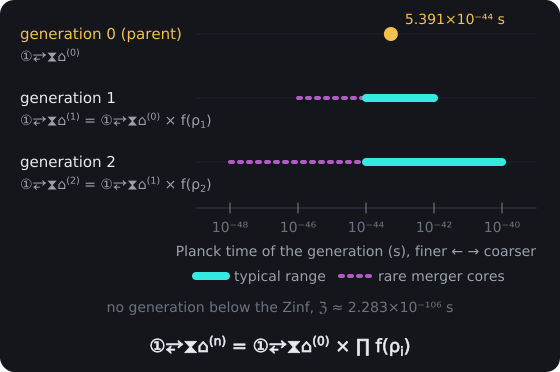
Planck Time Across Generations. Each generation's Planck time is its parent's times the scaling of its own collapse, ①⥂⧗⌂⁽ⁿ⁾ = ①⥂⧗⌂⁽⁰⁾ × ∏ f(ρᵢ), so the typical range widens from generation to generation, with rare merger cores reaching finer resolutions. No generation's Tempo falls below the Zinf ℨ.
Where Barrow and Tipler's anthropic cosmological principle (Barrow & Tipler, 1986) treats fine-tuning as a selection effect, Multi-Generational Complexity Evolution would provide mechanisms for environments suitable for life to emerge statistically, addressing fine-tuning through cosmic evolution rather than coincidence.
Thus, multi-generational evolution reveals a cosmos that grows more intricate with every collapse and rebirth, weaving fine-tuned environments from recursive law rather than chance. Complexity becomes the natural outcome of density-driven inheritance, showing that life-supporting conditions are not improbable anomalies but expected branches on the expanding tree of cosmic computation.
Deterministic Branching Architecture
Causal Structure Properties (G) include branch points where Null Well Formations (G) create new Causal Domains, node characteristics with unique parameter sets defining local physics, and connectivity rules governing information flow constraints between generations — cosmic genealogy with computational DNA.
Sorkin's causal set theory (Sorkin, 2007) provides frameworks for understanding fundamentally discrete spacetime structures, aligning with Discrete Causal Architecture models.
Deterministic Elements include binary Pulse rules remaining invariant and computable, initial conditions completely determining offspring parameters, causal consistency maintained within each domain, and predictable branching patterns from collapse dynamics.
Structured Randomness manifests as apparent randomness from computational complexity, sensitive dependence on initial conditions creating diversity, Pseudo-Random Sequences (G) from deterministic rules, and statistical patterns from recursive interactions. At the quantum scale, apparent randomness from deterministic rules has to meet Bell's theorem. This is how BPT meets Bell's theorem (Bell, 1964) and the loophole-free tests that confirm its violation (Hensen et al., 2015; Giustina et al., 2015; Shalm et al., 2015): no local hidden variables cross space; the correlation comes from the shared loop that all data passes through, the UniSphere and the Zinf; and no message can be sent faster than light, since each observer's result looks random until the results are compared by ordinary means.
Master Evolution Equation G
∂Ψ_n/∂τ = H⌂[Ψ_n] + Σ_i C‵[Ψ_{n-1}, ρ_i, S_i] [mixed units/dimensionless time]
Where:
- ∂Ψ_n/∂τ [mixed units] - evolutionary rate of nth generation parameter set
- Ψ_n [mixed units] - parameter set for generation n
- n [∅] - generation number
- τ [∅] - dimensionless evolutionary parameter
- H⌂ [𝕄·𝕃²·𝕋⁻²] - Hamiltonian operator for isolated Universe evolution
- Σ [∅] - summation operator
- i [∅] - index for all Null Wells in generation n-1
- C‵ [mixed units] - coupling terms from parent Universe collapse events
- Ψ_{n-1} [mixed units] - parameter set for generation n-1
- ρ_i [𝕄·𝕃⁻³] - density at collapse event i
- S_i [𝕄·𝕃²·𝕋⁻²·Θ⁻¹] - entropy at collapse event i
➢ Evolution equation governing cosmic DNA inheritance across generations, enabling predictable yet diverse cosmological evolution toward increasing computational sophistication, demonstrating how Hamiltonian evolution with inheritance coupling establishes generational parameter dynamics that characterizes predictable diversity in cosmic evolution toward computational advancement in substrate architectures.
Taken together, this framework reveals a universe where deterministic law and structured randomness interlace: collapse events seed diversity, causal rules preserve consistency, and the Master Evolution Equation guides recursive inheritance across generations. In this view, cosmic branching is not chaotic proliferation but a patterned genealogy, where predictable dynamics ensure order and computational richness guarantees diversity — a universe that evolves as a living architecture of recursive design.
9.3 Testable Predictions
- Cosmic Microwave Background Angular Correlations: exhibiting characteristic patterns reflecting parent Universe structure through Phase Coupling Equation relationships at angular scales ℓ ≈ 200-1000, measurable via enhanced statistical power in multipole analysis revealing non-random angular dependencies.
- Fine Structure Constant Spatial Gradients: showing systematic variations correlated with large-scale structure formation following f(ρ⦰) dependencies at precision levels Δα/α ≈ 10⁻⁶, observable through coordinated spectroscopic surveys across multiple cosmic domains.
- Gravitational Wave Frequency Signatures: from primordial Null Well collapse events producing characteristic spectral features at f ∝ 1/①⥂⧗'⌂ frequencies detectable by future space-based observatories, identifiable through characteristic chirp patterns distinct from binary merger signals.
- Multi-Generational Complexity Scaling: following exponential growth patterns in information processing capacity across cosmic generations, quantifiable through analysis of hierarchical structure formation rates exceeding standard cosmological predictions.
- Branching Topology Correlations: in galaxy cluster distributions reflecting deterministic inheritance patterns rather than random formation processes, measurable via network analysis of large-scale structure connectivity patterns.
- Temporal Evolution Signatures: in fundamental constant variations during cosmic phase transitions indicating recursive parameter inheritance mechanisms, traceable through precision measurements of constant evolution across redshift epochs.
These predictions may establish a framework for understanding cosmic evolution as computational genealogy where Universes inherit and evolve physical constants like cosmic DNA, addressing fine-tuning through evolutionary processes rather than anthropic arguments.