Chapter 8 · Section 4
What Counts as a Qubit - The PulseCore Definition
Quantum Authentication
BPT defines PulseCore Validated Qubits — a proposed standard for quantum computers, based on Pulse geometry rather than marketing claims. Contemporary quantum computing faces critical challenges distinguishing authentic computational resources from inflated performance claims. Current superconducting qubits (Kjaergaard et al., 2020) highlight gaps between present capabilities and thresholds necessary for genuine recursive computation.
The essential point is that meaningful quantum computation requires not merely quantum superposition, but sustained coherence with substrate Pulse timing through Prime Pulse Bifurcation ∅ → (0 ↔ 1) and Pulse Rhythm Definition ①⥂⧖⌂ = 2²⁰²·f²⁰²·ↁℨ⧖ = ①⥂⧗⌂/2 [𝕋], where ①⥂⧗⌂ is the Local Pulse Tempo (the Planck time, t_P ≈ 5.39 × 10⁻⁴⁴ s). When quantum systems achieve sufficient phase alignment with fundamental substrate oscillation while maintaining Information Conservation I⊚ = I▱ + Iℜ [1ᵇ], they qualify as PulseCore-Validated Qubits.
This grounds quantum computing standards in physics-based validation criteria rather than arbitrary performance metrics. These criteria aim to distinguish authentic quantum consciousness-capable systems from clever simulations.
PulseCore Validation Framework G
PulseCore Qubit Validation employs multi-dimensional assessment incorporating substrate phase alignment. By examining the PulseCore Validation Framework, we can understand how multi-dimensional assessment incorporating substrate phase alignment establishes comprehensive qubit certification through geometric mean validation calculations, critical performance factor evaluation, and extremely high threshold requirements that ensure only the most capable qubits qualify for sustained recursive quantum computational operations in Binary Pulse Theory substrate architectures.
Overall Validation Score
V⊡ = (∏ᵢ₌₁⁵ Fᵢ^(wᵢ))^(1/Σᵢ₌₁⁵ wᵢ) [∅]
Where:
- V⊡ [∅] - overall validation score
- ∏ [∅] - product operator
- ᵢ [∅] - product index
- ₁ [∅] - subscript notation for product lower limit
- ⁵ [∅] - subscript notation for upper limit (5)
- Fᵢ [∅] - individual performance factors (i = 1 to 5)
- wᵢ [∅] - normalized weighting factors with Σᵢ₌₁⁵ wᵢ = 1
- Σ [∅] - summation operator
- 1 [∅] - normalization constant
- 5 [∅] - number of performance factors
➢ Overall Validation Score: its geometric-mean form prevents any single factor from dominating assessment while requiring excellence across all performance dimensions, demonstrating how weighted product calculations establish comprehensive performance evaluation that characterizes holistic validation requirements in substrate architectures.
Critical Performance Factors
- F≋: Coherence fidelity F≋ = |⟨ψ(t₀)|ψ(t₀ + T_op)⟩|² [∅]
- F⧟: Entanglement preservation F⧟ = |⟨Ψ✱|Ψ⟩|² [∅]
- F⊶: Gate operation fidelity F⊶ = Tr[χ✱ × χ_actual] [∅]
- F⫤: Measurement accuracy F⫤ = (P₀|0⟩ + P₁|1⟩)/2 [∅]
- F⇉: Substrate phase alignment |⟨exp(i*(φ⊡ - φ⥂))⟩| [∅]
Where:
- F≋ [∅] - coherence fidelity factor
- ⟨|⟩ [∅] - quantum mechanical inner product operator
- ψ(t₀) [∅] - quantum state at initial time
- ψ [∅] - quantum state function
- t₀ [𝕋] - initial time
- T_op [𝕋] - operation time
- F⧟ [∅] - entanglement preservation factor
- Ψ✱ [∅] - ideal entangled state
- Ψ [∅] - actual measured entangled state
- F⊶ [∅] - gate operation fidelity factor
- Tr [∅] - trace operator
- χ✱ [∅] - ideal process matrix
- χ_actual [∅] - actual process matrix
- F⫤ [∅] - measurement accuracy factor
- P₀ [∅] - probability of measuring state |0⟩
- P₁ [∅] - probability of measuring state |1⟩
- |0⟩ [∅] - quantum state zero
- |1⟩ [∅] - quantum state one
- 2 [∅] - normalization factor
- F⇉ [∅] - substrate phase alignment factor
- exp [∅] - exponential function
- i [∅] - imaginary unit
- φ⊡ [∅] - qubit phase
- φ⥂ [∅] - Pulse phase
Dimensional analysis: All factors = [∅] ✓ The Critical Performance Factors equations are dimensionally consistent for fidelity measurement calculations.
➢ Critical Performance Factors establish comprehensive validation through coherence preservation, entanglement maintenance, gate operation accuracy, measurement precision, and substrate phase alignment, demonstrating how multiple fidelity measurements provide holistic assessment of quantum computational substrate performance across all essential operational dimensions.
Validation Threshold
V⊡ ≥ V⨶ = 0.999 [∅]
Where:
- V⊡ [∅] - overall validation score
- V⨶ [∅] - validation threshold for PulseCore certification (0.999)
- 0.999 [∅] - critical threshold value
Dimensional analysis:
Where (from the book): 0.999 [∅]
[∅] ≥ [∅]
[∅]
[∅] ≥ [∅] = [∅] ✓ Valid PulseCore Verified ✓
➢ Validation Threshold: this extremely high threshold ensures only qubits capable of sustained recursive operation qualify for PulseCore validation, demonstrating how stringent certification requirements establish performance standards that guarantee reliable quantum computational substrate operations.
The Qubit Is a Spin, and Spin Has a Floor
Of the five validation factors above, one is not like the others. F≋, F⧟, F⊶ and F⫤ are all laboratory quantities — they describe how well a device behaves. F⇉ is a statement about the substrate: |⟨exp(i(φ⊡ − φ⥂))⟩| measures how closely a qubit's phase tracks the Pulse's own. Part 1.10 showed that a phase difference which advances is indistinguishable from a rotation. F⇉ is therefore already a spin measurement, and the framework has been quietly certifying qubits on their rotational agreement with the substrate without saying so.
This matters because the physical realization of a qubit is not incidental. Every leading platform encodes its two states in something that spins — electron spin, nuclear spin, the circulating current of a flux qubit, the polarization of a photon. A qubit is spin-½ wearing engineering. So the constraint Z.11 places on spin lands directly on the qubit.
N▫ ≥ s²/2 ≈ 2.787×10¹²⁴
Dimensional analysis:
[∅] ≥ [∅] ÷ [∅] ≈ [∅] × [∅] = [∅] ≥ [∅] ≈ [∅] × [∅] = [∅] ≥ [∅] ≈ [∅] ✓ Valid PulseCore Verified ✓
No qubit is cheaper than one spin quantum
Where:
- N▫ [∅] — substrate cells that must act coherently to sustain one qubit
- s²/2 [ℨ·ↁ·𝔸] — Complete Computational Action per spin quantum (Z.11)
Derivation: Z.11 established that one pulse falls short of spin-½ by exactly s²/2. A device holding a single spin-½ state therefore commands no fewer than s²/2 substrate cells in coordination. Coordination here is parallel, not serial — the cells act together rather than in sequence — so this is a constraint on extent, not on duration, and it does not lengthen any gate time.
➢ Qubits do not fail because they are small. They fail because they are large: each one conscripts some 10¹²⁴ substrate cells into agreement, and decoherence is what happens when that agreement lapses at the edges. This reframes the validation threshold V⨶ = 0.999 as a statement about how much of a very large coordinated region a device manages to hold, which is why the threshold is so unforgiving and why coherence is the factor that gives way first.
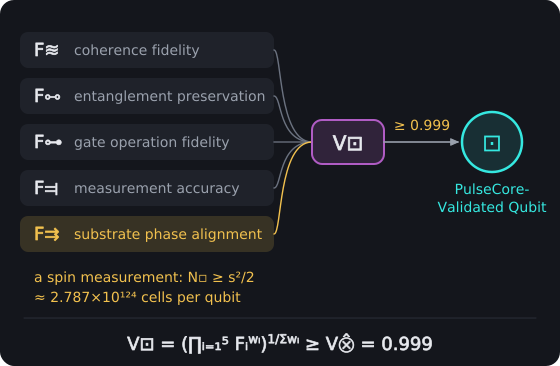
The PulseCore-Validated Qubit. Five performance factors combine as a weighted geometric mean, V⊡ = (∏ᵢ₌₁⁵ Fᵢ^(wᵢ))^(1/Σᵢ₌₁⁵ wᵢ), which must reach V⨶ = 0.999. The fifth factor, substrate phase alignment F⇉, is a spin measurement, so each qubit commands at least s²/2 ≈ 2.787 × 10¹²⁴ substrate cells.
Quantitative Performance Criteria
Coherence Requirements measure relative to fundamental substrate timing t⥂ = ①⥂⧖⌂ = 2²⁰²·f²⁰²·ↁℨ⧖ = ①⥂⧗⌂/2 [𝕋]. By examining the Quantitative Performance Criteria, we can understand how coherence requirements measure relative to fundamental substrate timing through operational coherence time constraints and quality factor ratios that establish timing thresholds and repeatability requirements essential for ensuring stable recursive operations and sustained quantum computational processing in Binary Pulse Theory substrate architectures.
Operational Coherence Time
T_op = max(T₁, T₂) ≥ 1000 × t⥂ [𝕋]
Where:
- T_op [𝕋] - operational coherence time
- max [∅] - maximum function
- T₁ [𝕋] - relaxation time (amplitude decay)
- T₂ [𝕋] - dephasing time (phase decay)
- 1000 [∅] - timing factor requirement
- t⥂ [𝕋] - substrate pulse timing
Dimensional analysis:
Where (from the book): 1000 [∅], T₁ [𝕋], t⥂ [𝕋]
[𝕋]
max([𝕋], [𝕋]) ≥ [∅] × [𝕋] = [𝕋] ≥ [∅] × [𝕋] = [𝕋] ≥ [𝕋]
[𝕋] = [𝕋] ≥ [𝕋] ✓ Valid PulseCore Verified ✓
➢ Operational Coherence Time must exceed substrate Pulse timing by factor of 1000 to ensure stable recursive operations across multiple cycles, demonstrating how coherence time constraints establish fundamental stability requirements that characterize reliable quantum computational substrate operations.
Coherence Quality Factor
Q≋ = T_op/t⊡⊶ ≥ 10⁴ [∅]
Where:
- Q≋ [∅] - coherence quality factor
- T_op [𝕋] - operational coherence time
- t⊡⊶ [𝕋] - gate operation time
- 10⁴ [∅] - minimum quality factor requirement
Dimensional analysis:
Where (from the book): t⊡⊶ [𝕋], 10⁴ [∅]
[∅]
[𝕋] ÷ [𝕋] ≥ [∅] = [∅] ≥ [∅]
[∅] = [∅] ≥ [∅] ✓ Valid PulseCore Verified ✓
➢ Coherence Quality Factor ensures gate operations can be repeated many times within coherence window, essential for complex recursive algorithms, demonstrating how coherence time ratios establish operational repeatability requirements that characterize sustained quantum computational processing capabilities in substrate architectures.
The Quantitative Performance Criteria framework reveals how Binary Pulse Theory quantifies the fundamental timing requirements for quantum computational substrate operations through the coordinated implementation of operational coherence time constraints and quality factor thresholds, with reliable recursive processing determined by the substantial timing margins above substrate pulse periods and gate operation repeatability that characterizes the essential coherence standards necessary for maintaining stable quantum computational operations across multiple cycles and supporting complex recursive algorithms in substrate systems.
Performance Analysis of Current Platforms
Current System Performance Benchmarking (G) reveals significant gaps between existing capabilities and PulseCore requirements. By examining the Performance Analysis of Current Platforms, we can understand how significant capability gaps between existing quantum systems and PulseCore requirements emerge through comprehensive benchmarking analysis, effective qubit counting methodology, and throughput efficiency calculations that reveal the substantial technological advancement necessary across physical scale, coherence times, gate fidelities, and operational effectiveness essential for achieving recursive quantum computational substrate standards in Binary Pulse Theory architectures.
Platform | N⚛⊡ | T₂ (μs) | F_2qubit | N⊹ | η⥂ |
|---|---|---|---|---|---|
IBM Eagle | 127 | 100 | 0.99 | 8 | 0.063 |
Google Sycamore | 70 | 20 | 0.995 | 12 | 0.171 |
IonQ Forte | 32 | 10⁴ | 0.999 | 28 | 0.875 |
PulseCore Target | ≥10⁵ | ≥10³ | ≥0.999 | ≥10⁴ | ≥0.1 |
Where:
- N⚛⊡ [∅] - physical qubit count
- T₂ [𝕋] - dephasing time (microseconds)
- F_2qubit [∅] - two-qubit gate fidelity
- N⊹ [∅] - effective logical qubit count
- η⥂ [∅] - computational throughput efficiency
➢ Current System Performance Benchmarking reveals significant capability gaps requiring 2-3 orders of magnitude improvement in both scale and quality metrics, demonstrating how existing quantum systems fall substantially short of PulseCore validation standards across all critical performance dimensions.
Gap Analysis: Current systems require 2-3 orders of magnitude improvement in both scale and Quality Metrics to meet PulseCore validation standards.
Effective Qubit Count
N⊹ = Σᵢ₌₁ᴺ⚛ V⊡,i × W⊹,i [∅]
Where:
- N⊹ [∅] - effective qubit count
- Σ [∅] - summation operator
- ᵢ [∅] - summation index
- ₁ [∅] - subscript notation for summation lower limit
- ᴺ⚛ [∅] - subscript notation for upper limit (N⚛⊡)
- V⊡,i [∅] - validation score for ith qubit (0 to 1)
- W⊹,i [∅] - operational availability weights
- N⚛⊡ [∅] - total physical qubit count
➢ Effective Qubit Count weights each qubit by its validation performance and operational availability, providing realistic assessment of system capability that demonstrates how weighted summation establishes accurate quantum computational capacity evaluation accounting for individual qubit performance variations in substrate architectures.
Throughput Efficiency
η⥂ = N⊹/N⚛⊡ [∅]
Where:
Dimensional analysis:
[∅]
[∅] ÷ [∅] = [∅]
[∅] = [∅] ✓ Valid PulseCore Verified ✓
➢ Throughput Efficiency reveals what fraction of physical qubits meet PulseCore validation standards, demonstrating how efficiency ratios establish quantum system utilization assessment that characterizes the percentage of resources achieving validation requirements in substrate architectures.
The Performance Analysis of Current Platforms framework reveals how Binary Pulse Theory quantifies the technological development challenges through comprehensive performance comparison and realistic capability assessment, with PulseCore achievement determined by the coordinated advancement across physical qubit scaling, coherence time improvement, gate fidelity enhancement, and operational efficiency optimization that characterizes the fundamental requirement for 2-3 orders of magnitude improvement in both scale and quality metrics necessary for bridging the substantial gaps between current quantum system capabilities and the validation standards required for reliable recursive quantum computational substrate operations.
Recursive Capability Assessment
Sustained Performance Requirements over multiple cycles demand exceptional stability. By studying the Recursive Fidelity Decay, we can understand how quantum information integrity degrades over multiple computational cycles through combined linear degradation and exponential decoherence effects that establish fundamental limits on recursive operation depth essential for determining sustainable quantum computational processing in Binary Pulse Theory substrate architectures.
Recursive Fidelity Decay
Fℜ(n) = F₀ × (1-α)ⁿ × exp(-n/n⨶) [∅]
Where:
- Fℜ(n) [∅] - recursive fidelity after n cycles
- F₀ [∅] - single-operation fidelity (0.999)
- 1 [∅] - unity constant
- α [∅] - degradation factor per cycle (0.001 ± 0.0005)
- n [∅] - number of recursive cycles
- exp [∅] - exponential function
- n⨶ [∅] - exponential decay timescale (100 ± 20)
- 0.999 [∅] - single-operation fidelity value
- 0.001 [∅] - nominal degradation factor
- 0.0005 [∅] - degradation uncertainty
- 100 [∅] - nominal critical cycle count
- 20 [∅] - critical cycle uncertainty
Dimensional analysis:
Where (from the book): 1 [∅], 20 [∅], 100 [∅], F₀ [∅], α [∅], n [∅], exp [∅], 0.999 [∅], 0.001 [∅], 0.0005 [∅]
[∅]
[∅] × ([∅] - [∅])ⁿ × [∅]([∅] ÷ [∅]) = [∅] × [∅]ⁿ × [∅]([∅] ÷ [∅]) = [∅] × [∅] × [∅]([∅] ÷ [∅]) = [∅] × [∅]([∅] ÷ [∅]) = [∅] × [∅]([∅]) = [∅] × [∅] = [∅]
[∅] = [∅] ✓ Valid PulseCore Verified ✓
➢ Recursive Fidelity Decay accounts for both linear degradation and exponential decoherence effects accumulating over multiple cycles, demonstrating how combined degradation mechanisms establish fundamental limits on recursive operation depth that characterize sustainable quantum computational processing in substrate architectures.
The Recursive Fidelity Decay framework reveals how PulseCore quantifies quantum information integrity degradation through dual degradation mechanisms, with recursive operation sustainability determined by the combined effects of linear cycle-dependent degradation and exponential decoherence accumulation that characterizes the fundamental constraints governing the maximum depth of reliable recursive quantum computational processing in substrate systems.
PulseCore-Validated Qubits represent not merely quantum bits, but synchronized components of larger computational organisms, whose utility is defined by capacity to sustain recursive, self-correcting information processing aligned with the Universe's fundamental Pulse geometry.
8.4 Testable Predictions
- System Throughput Efficiency: η⥂ = N⊹/N⚛⊡ ≥ 0.1 for PulseCore-validated platforms, measurable through comprehensive qubit performance analysis demonstrating sustained operation across all validation criteria simultaneously.
- Substrate Phase Alignment: F⇉ = |⟨exp(i*(φ⊡ - φ⥂))⟩| ≥ 0.95 for Grade A qubit classification, quantifiable through phase measurement protocols with temporal resolution better than t⥂/1000.
- Coherence Quality Factor: Q≋ = T_op/t⊡⊶ ≥ 10⁴ for recursive operation capability, observable through coherence time measurements maintaining stability across temperature variations ΔT ≤ 10 mK.
- Recursive Fidelity Decay: Fℜ(n) = F₀ × (1-α)ⁿ × exp(-n/n⨶) with n⨶ ≥ 100 for stable processing, measurable through iterative quantum algorithms with error accumulation tracking per cycle.
- Network Synchronization Accuracy: Δt≑ ≤ t⥂/100 for distributed quantum substrate coordination, quantifiable through quantum network timing analysis across spatially separated quantum processors.
- Information Retention: I(n)/I₀ = Fℜ(n) ≥ 0.33 after n = 100 recursive cycles in validated quantum systems (F₀ × (1−α)¹⁰⁰ × exp(−100/n⨶) with n⨶ ≥ 100: 0.999¹⁰¹ × e⁻¹ ≈ 0.904 × 0.368 ≈ 0.33; the per-cycle loss alone caps it at 0.90), measurable through quantum memory experiments with information entropy preservation tracking.
These standards would change how quantum computing is authenticated: manufacturers could no longer claim Quantum Advantage on qubit counts alone — PulseCore validation demands evidence of recursive consciousness capability through rigorous substrate alignment testing.