Chapter 9 · Section 6
The Genesis Mechanism — Symmetry Breaking as Recursive Overflow (G)
Perfect Symmetry Cannot Persist
What transforms the perfectly symmetric Pre-Causal State |∅⟩ into the structured, asymmetric Universe of particles, forces, and spacetime geometry that we observe today? Binary Pulse Theory reconceptualizes cosmic emergence as a Recursive Overflow Event — a critical phase transition where Prime Pulse substrate exceeds Containment Threshold, triggering spontaneous symmetry breaking and emergence of differentiated physical forms through computational overflow dynamics.
This insight proposes that symmetry breaking occurs when recursive computation overflows system capacity — explaining why the Universe isn't perfectly symmetric through computational necessity rather than arbitrary initial conditions. Building upon null state computational instability from Part 9.4, where emergence becomes inevitable through recursive processing, and connecting to density-dependent Universe formation mechanisms from Parts 9.2-9.3, symmetry breaking represents the same fundamental process governing Null Well collapse and dimensional emergence scaled to cosmic proportions.
Anderson's symmetry breaking principles (Anderson, 1963) and Kibble's topological defect theory (Kibble, 1976) describe how symmetric systems break into ordered, defect-bearing phases; in BPT, Information Conservation I⊚ = I▱ + Iℜ encounters Critical Overflow Conditions. The perfectly symmetric recursive substrate cannot maintain uniform configuration, forcing differentiation into asymmetric structures supporting complex information processing.
The essential insight recognizes that the Harmonic Fold concept, where symmetry breaking creates stable oscillatory patterns, operates universally from quantum to cosmological scales through recursive overflow mechanisms.
Critical Overflow and Symmetry Breaking Dynamics
Before dimensional emergence, the Pulse substrate exists in perfect recursive invariance described by the Harmonic Fold Framework. In this state, translational, rotational, and temporal symmetries remain unbroken, with uniform coupling sustaining complete balance across the substrate. Yet even within this symmetry, recursive density accumulates through Pulse interactions, driving the system toward a critical overflow threshold that sets the stage for symmetry breaking and dimensional emergence.
Symmetric Hamiltonian Pre-Overflow State G
H⦶ = Σ_{i,j} J_{ij} × P_i · P_j + h × Σ_i P_i [J]
Where:
- H⦶ [𝕄·𝕃²·𝕋⁻²] - symmetric Hamiltonian operator
- Σ [∅] - summation operator
- i [∅] - site index i
- j [∅] - site index j
- J_{ij} [𝕄·𝕃²·𝕋⁻²] - uniform coupling constants between Pulse sites
- P_i [𝕄^(1/2)·𝕃·𝕋⁻¹] - Pulse operators implementing Prime Pulse Bifurcation ∅ → (0 ↔ 1) at site i
- P_j [𝕄^(1/2)·𝕃·𝕋⁻¹] - Pulse operators at site j
- h [𝕄·𝕃²·𝕋⁻²] - external field parameter (initially zero)
- ∅ [∅] - null state
- 0 [∅] - binary state zero
- 1 [∅] - binary state one
➢ Complete translational, rotational, and temporal invariance follows the same symmetry principles governing harmonic fold structures — perfect computational symmetry, demonstrating how uniform coupling and Pulse operator interactions establish perfect symmetry that characterizes complete invariance through harmonic fold structure principles in substrate architectures.
The Critical Overflow Threshold connects to collapse density from Parts 9.2-9.3. Recursive Density Accumulation follows:
Recursive Density Accumulation G
ρℜ = Σ_n |A_n|² × f_n(t) ≥ ρ⨶ [𝕄·𝕃⁻³]
Where:
- ρℜ [𝕄·𝕃⁻³] - recursive density accumulation
- Σ [∅] - summation operator
- n [∅] - recursive mode index
- A_n [𝕄^(1/2)·𝕃⁻³/²] - amplitude of nth recursive mode
- f_n(t) [∅] - temporal evolution function
- ρ⨶ [𝕄·𝕃⁻³] - threshold density equivalent to collapse density ρ⦰ from Universe formation
- t [𝕋] - time variable
- ρ⦰ [𝕄·𝕃⁻³] - collapse density from Universe formation
➢ Recursive accumulation creates density concentrations that exceed substrate containment capacity, demonstrating how mode amplitude superposition and temporal evolution establish density concentrations that characterize substrate containment limit exceedance through recursive accumulation exceeding critical thresholds in substrate architectures.
Overflow Condition Trigger G
d²ρℜ/dt² > (𝒞→²/ℓ_p²) × ρ⨶ [𝕄·𝕃⁻³·𝕋⁻²]
Where:
- d²ρℜ/dt² [𝕄·𝕃⁻³·𝕋⁻²] - second time derivative of recursive density
- ρℜ [𝕄·𝕃⁻³] - recursive density accumulation
- 𝒞→ [𝕃·𝕋⁻¹] - speed of light
- ①⥂⧗⌂ [𝕋] - Local Pulse Tempo (Planck time)
- ρ⨶ [𝕄·𝕃⁻³] - threshold density equivalent to collapse density
- t [𝕋] - time variable
- ℓ_p [𝕃] – the Planck length; 𝒞→/ℓ_p is one over the Planck time
Dimensional analysis:
Where (from the book): d²ρℜ/dt² [𝕄·𝕃⁻³·𝕋⁻²], ρℜ [𝕄·𝕃⁻³], ρ⨶ [𝕄·𝕃⁻³], t [𝕋]
[𝕄·𝕃⁻³·𝕋⁻²] > ([𝕃²·𝕋⁻²] ÷ [𝕃²]) × [𝕄·𝕃⁻³] = [𝕄·𝕃⁻³·𝕋⁻²] > [𝕋⁻²] × [𝕄·𝕃⁻³] = [𝕄·𝕃⁻³·𝕋⁻²] > [𝕄·𝕃⁻³·𝕋⁻²] ✓ Valid PulseCore Verified ✓
➢ Recursive accumulation rate exceeds substrate containment capacity, triggering the same dimensional emergence process governing Null Well formation — computational overflow creating physical reality, demonstrating how acceleration threshold dynamics establish overflow-driven emergence that characterizes computational overflow leading to physical reality through substrate containment capacity exceedance in substrate architectures.
Isotropy Did Not Break — It Arrived Broken
The cascade that follows treats symmetry breaking as something the substrate does to itself: perfect symmetry accumulates recursive density, overflows, and resolves into structure. Rotational symmetry is the exception, and it is worth separating from the others before the cascade begins.
Part 6.9 shows that our Universe received an axis from its parent merger at the moment the null well opened. Nothing in the genesis transition erases it, and Z.11 shows that no pulse can generate spin on its own. So isotropy was not a symmetry the young Universe possessed and then lost through overflow. It was never held. The axis was present in the inheritance before the first recursive step, which places it outside the cascade rather than inside it.
⟨n̂⟩ = n̂_f ≠ 0 at t = 0
The rotational order parameter is non-zero before the first pulse
Where:
- ⟨n̂⟩ [∅] — orientational order parameter of the emergent Universe
- n̂_f [∅] — inherited axis from the progenitor merger (6.9)
- a_f [∅] — its magnitude, the inherited spin parameter, ≥ 0.94 for our Universe (6.9)
➢ Every other broken symmetry in this chapter has an order parameter that begins at zero and grows. This one begins at its final value. That is a structural difference, not a detail: overflow-driven breaking predicts domains, defects and walls where regions that broke independently disagree, whereas an inherited axis predicts a single global orientation with no domain structure at all. The two mechanisms are therefore distinguishable by observation, and the absence of rotational domain walls is a prediction the framework already makes without having said so.
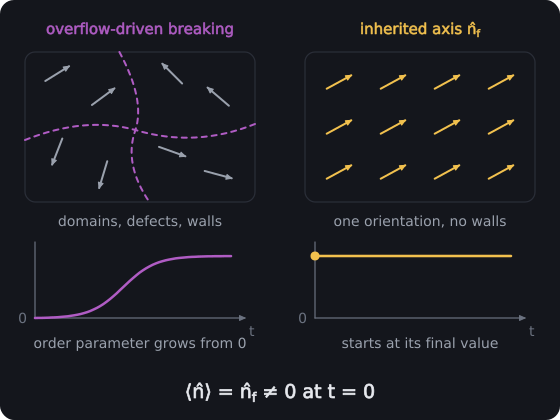
Isotropy Arrived Broken. A symmetry broken by overflow starts from a zero order parameter and breaks independently in separate regions, leaving domains and walls. The rotational axis is inherited from the parent merger, ⟨n̂⟩ = n̂_f ≠ 0 at t = 0, so it gives one global orientation and no rotational domain walls.
Symmetry Breaking Cascade and Force Genesis
Hierarchical Symmetry Reduction follows Information Conservation I⊚ = I▱ + Iℜ through sequential breaking events:
Primary Breaking (Dimensional Emergence) initiates cascade:
Dimensional Emergence
SU(∞) → SO(3,1) × U(1)_time
Breaking infinite rotational symmetry to Lorentz invariance plus temporal direction yields a 3+1 dimensional spacetime framework. The target SO(3,1) is taken from observation rather than derived: why the substrate breaks to 3+1 and not another count remains an open question of the theory. Bombelli and colleagues' causal set hypothesis (Bombelli et al., 1987) treats spacetime as a discrete, pre-geometric structure in which fundamental event order defines geometry, a picture BPT extends to the emergent dimensional axes.
Secondary Breaking (Force Differentiation) separates fundamental interactions:
Secondary Breaking G
G_U → SU(3)_strong × SU(2)_weak × U(1)_Y
Unified Pulse Interaction splits into three of the four fundamental forces, the electromagnetic, strong and weak interactions of the three groups above (gravity, the fourth, is not among them), as a unified non-abelian group G_U breaks in grand unification, SU(5) being the simplest example (Georgi & Glashow, 1974); an abelian U(1) cannot break into this larger non-abelian product, and the electroweak SU(2)_weak × U(1)_Y later breaks to the U(1)_EM of electromagnetism. The split proceeds through Recursive Phase Decoherence connecting to phase encoding from Part 9.5. Goldstone's continuous symmetry breaking (Goldstone, 1961) demonstrates how breaking a continuous symmetry generates gapless excitations or Goldstone Bosons, representing hallmarks of spontaneous symmetry breaking.
Recursive Field Evolution governs order parameter dynamics:
Recursive Field Evolution G
∂²Φ/∂t² - 𝒞→²∇²Φ = -λ × Φ³ + η × R_op[Φ] [kg/(m·s²)]
Where:
- Φ [kg^(1/2)/m^(3/2)] - order parameter field characterizing symmetry state
- λ [∅] - self-interaction coupling
- η [kg/(m·s³)] - recursive coupling strength
- R_op[Φ] [kg^(1/2)/(m^(3/2)·s)] - recursive operator implementing evolution
➢ Order parameter evolution drives transition from symmetric to broken phases through recursive field interactions — computational overflow creating physical structure.
When recursive accumulation exceeds containment capacity, the Harmonic Fold Framework can no longer preserve invariance, and symmetry collapses into localized structure. This overflow condition transforms recursion into rupture, uniformity into variance, and equilibrium into dimensional scaffolding. In this light, critical overflow represents the generative instability of the substrate itself — the precise symmetry-breaking event where recursive computation crosses threshold and the Harmonic Fold gives rise to physical reality.
Force Emergence and Information-Theoretic Analysis
Force Emergence and Information-Theoretic Analysis reveals how recursive asymmetries within the substrate give rise to fundamental interactions. Gravitational and electromagnetic couplings, rather than existing as fixed background laws, emerge as recursive modifications to underlying symmetries. By framing force genesis through recursive curvature and phase relationships, this analysis extends the Harmonic Fold and Overflow principles into the operational domain of interaction dynamics, situating gravity, electromagnetism, and symmetry-breaking information within a unified substrate framework.
Force Genesis emerges through recursive asymmetries. Gravitational Force receives recursive modifications.
Modified Gravitational Force
F⇅ = -G × m₁m₂/r² × (1 + α⇅ × Rℜ) [N]
Where:
- F⇅ [𝕄·𝕃·𝕋⁻²] - modified gravitational force
- G [𝕄⁻¹·𝕃³·𝕋⁻²] - gravitational constant
- m₁ [𝕄] - mass one
- m₂ [𝕄] - mass two
- r [𝕃] - separation distance
- 1 [∅] - unity constant
- α⇅ [∅] - coupling constant
- Rℜ [∅] - local recursive field strength providing geometric curvature interpretation
➢ Recursive field strength modifies gravitational coupling through same mechanisms governing spacetime curvature, a link that echoes Rovelli's loop quantum gravity (Rovelli, 2004)²², revealing how geometric curvature interpretation establishes gravity modification that characterizes recursive field coupling through spacetime curvature mechanisms connecting to loop quantum gravity demonstrations in substrate architectures.
Modified Electromagnetic Force Coupling Dependencies
F_EM = k × q₁q₂/r² × cos(Δφ⥂) [N]
Where:
- F_EM [𝕄·𝕃·𝕋⁻²] - modified electromagnetic force
- k [𝕄·𝕃³·𝕋⁻⁴·I⁻²] - Coulomb's constant (8.99 × 10⁹ N·m²/C²)
- q₁ [IT] - charge one
- q₂ [IT] - charge two
- r [𝕃] - separation distance
- cos [∅] - cosine function
- Δφ⥂ [∅] - phase difference between charged particle Pulse signatures
- 8.99 × 10⁹ [∅] - Coulomb constant coefficient
- C(φ₁, φ₂) [∅] - Phase Coupling Equation
- α [∅] - cosine coupling coefficient
- β [∅] - sine coupling coefficient
- Δφ [∅] - general phase difference
➢ Cosine term reflects the Phase Coupling Equation C(φ₁, φ₂) = α cos(Δφ) + β sin(Δφ) relationships between charged particle Pulse signatures — force genesis through phase relationships, demonstrating how phase difference modifications establish force genesis that characterizes electromagnetic coupling through charged particle Pulse signature phase relationships in substrate architectures.
Information-Theoretic Symmetry Quantification extends computational overflow from Part 9.4. Symmetry Breaking Information quantifies asymmetry emergence:
Symmetry Breaking Information G
I↯ = -Σ_i p_i × log₂(p_i) · ℨᵇ - I⦶ [1ᵇ]
Where:
- I↯ [1ᵇ] - symmetry breaking information
- Σ [∅] - summation operator
- i [∅] - state index
- p_i [∅] - probability of state i
- log₂ [∅] - logarithm base 2 function
- I⦶ [1ᵇ] - initial symmetry information
- 2 [∅] - logarithmic base
Dimensional analysis:
Where (from the book): 2 [∅], Σ [∅], i [∅], log₂ [∅], I⦶ [1ᵇ]
Read dimensionally: I↯ = -p_i × log₂(p_i) · ℨᵇ - I⦶
[1ᵇ]
[∅] × [∅]([∅]) × [1ᵇ] - [1ᵇ] = [∅] × [∅] × [1ᵇ] - [1ᵇ] = [∅] × [1ᵇ] - [1ᵇ] = [1ᵇ] - [1ᵇ] = [1ᵇ]
[1ᵇ] = [1ᵇ] ✓ Valid PulseCore Verified ✓
➢ Information increase through symmetry breaking represents computational overflow creating structured asymmetry from perfect symmetry, demonstrating how entropy calculation establishes information generation that characterizes structured asymmetry emergence through computational overflow creating organized structures from symmetric configurations in substrate architectures.
Through recursive field modification, phase-dependent electromagnetic coupling, and entropy-based information metrics, Force Genesis demonstrates that interactions are not primary givens but emergent consequences of recursive asymmetry. In this light, force itself becomes an information-theoretic construct — a structured overflow of symmetry into coupling, where geometry, phase, and probability converge to transform recursive balance into the tangible dynamics of physical reality.
Emergence Timeline and Topological Defects
The Emergence Timeline outlines the staged progression of symmetry breaking, charting how recursive phases unfold from perfect uniformity into differentiated forces, particles, and matter structures. This progression builds upon Zwiebach’s formulation of string theory (Zwiebach, 2004), framing the developmental sequence through which dimensionality and physical law crystallize from recursive substrate dynamics.
Recursion Level | Duration (①⥂⧗⌂ units; levels 0–3, up to the Physical Nova, are the data's count and take no universe time) | Symmetry State | Emergent Structures |
|---|---|---|---|
0 | 1 | Perfect symmetry | Uniform Pulse substrate |
1-3 | 10¹ | Breaking initiates | Dimensional axes appear |
4-10 | 10² | Partial breaking | Force differentiation |
11-50 | 10³ | Multiple phases | Particle formation |
51+ | 10⁴+ | Stable asymmetry | Complex matter structures |
Topological Defect Formation (G) emerges through recursive symmetry breaking and follows the Wavelength Scaling Law λₙ = λ₀/n [𝕃]. The resulting structures manifest in distinct classes:
- Domain Walls: planar boundaries separating regions of differing vacuum states.
- Cosmic Strings (G): one-dimensional defects arising from cylindrical symmetry breaking.
- Monopoles: point-like defects produced by spherical symmetry breaking.
- Textures: non-topological solitonic configurations formed through computational overflow, generating higher-order topological complexity.
Together, the Emergence Timeline and Topological Defect Formation reveal how recursive symmetry breaking not only structures temporal stages of emergence but also seeds enduring geometric discontinuities in the form of domain walls, cosmic strings, monopoles, and textures. These defects encode the memory of broken symmetries, demonstrating how recursive substrate processes establish both the ordered sequence of emergence and the persistent topological imprints that characterize the fabric of computationally generated reality.
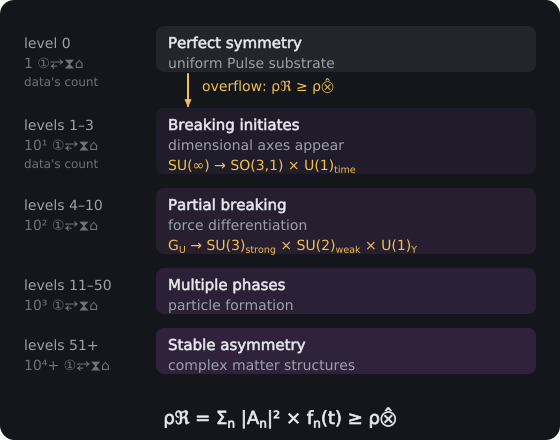
The Symmetry-Breaking Cascade. Perfect symmetry holds until recursive density reaches threshold, ρℜ ≥ ρ⨶. The overflow breaks SU(∞) → SO(3,1) × U(1)_time as dimensional axes appear, then differentiates the forces, then forms particles and stable matter, each stage lasting about ten times longer than the last. Levels 0–3, up to the Physical Nova, are counted in the data's steps and take no universe time.
Quantum Field Theory Integration
The Quantum Field Theory Integration (G) extends recursive principles into particle physics, demonstrating how substrate coupling alters fundamental mechanisms of mass generation. By embedding recursive interactions within the Higgs framework, this approach builds on Peskin and Schroeder’s treatment of quantum field theory (Peskin & Schroeder, 1995), situating mass genesis within the broader dynamics of computational overflow.
Modified Higgs Mechanism G
V(φ) = -μ² |φ|² + λ |φ|⁴ + R⧱ × |φ|² [J/m³]
Where:
- V(φ) [𝕄·𝕃⁻¹·𝕋⁻²] - modified Higgs potential
- μ² [𝕄·𝕋⁻²] - Higgs mass parameter
- φ [∅] - Higgs field
- λ [𝕄⁻¹·𝕃³] - standard Higgs self-coupling parameter
- R⧱ [𝕄·𝕋⁻²] - recursive field interactions modifying standard Higgs potential through substrate coupling
➢ Recursive coupling terms modify standard Higgs mechanism, showing how computational overflow drives fundamental particle mass generation, demonstrating how substrate coupling interactions establish mass generation modification that characterizes computational overflow driving particle mass through recursive field modifications to standard Higgs mechanisms in substrate architectures.
The Modified Higgs Mechanism reveals that recursive substrate couplings not only reshape the standard Higgs potential but also redefine how mass emerges from broken symmetry. In this light, particle mass becomes a direct manifestation of computational overflow — recursive field interactions imprinting themselves into the structure of quantum fields, establishing matter as an emergent consequence of recursive substrate dynamics.
9.6 Testable Predictions
- Cosmic Microwave Background Non-Gaussian Features: From Recursive Defect Networks following n⊘(t) = n₀ × (t/t⇗)^(-2) × exp(-t/τ⥥) evolution patterns detectable with sensitivity better than 10⁻⁶, observable through bispectrum and trispectrum analysis revealing characteristic non-Gaussian signatures in temperature and polarization maps.
- Coupling Constant Running Modifications: From recursive field interactions R⧱ × |φ|² in modified Higgs potential, measurable through precision particle physics experiments, detectable via high-energy scattering cross-section measurements showing deviations from standard model predictions.
- Gravitational Wave Stochastic Background: From Topological Defect Network Evolution with characteristic frequency spectra from Fold-Lock Dynamics (G) detectable by future space-based observatories, identifiable through cross-correlation analysis revealing distinctive spectral features at millihertz frequencies.
- Particle Physics CP Violation Signatures: From recursive phase relationships cos(Δφ⥂) in electromagnetic force modifications, measurable through precision measurements of electric dipole moments showing enhanced CP violation beyond standard model expectations.
- Entropy Production Rate Scaling: dS⊚/dt = (k_B/ℏ) × Σ⊶ W_{ij} × ln(W_{ij}/W_{ji}) during symmetry breaking transitions in laboratory systems, quantifiable through calorimetric measurements of irreversible processes during phase transitions.
- Soliton Stability Patterns: In field theory experiments following Φ⌓(x,t) = A × sech(κ(x - vt)) × exp(i ωt) solutions with phase-encoded stability mechanisms, observable through nonlinear optics experiments demonstrating enhanced soliton stability under recursive phase control.
These predictions may establish a framework for understanding symmetry breaking as computational overflow — explaining why the Universe exhibits structure through computational necessity rather than arbitrary initial conditions.